
Retrofitting Spray Foam in Older Missouri Homes
Older homes in Springfield and SW Missouri often lack modern insulation. Learn how spray foam retrofits can improve comfort and cut energy costs.
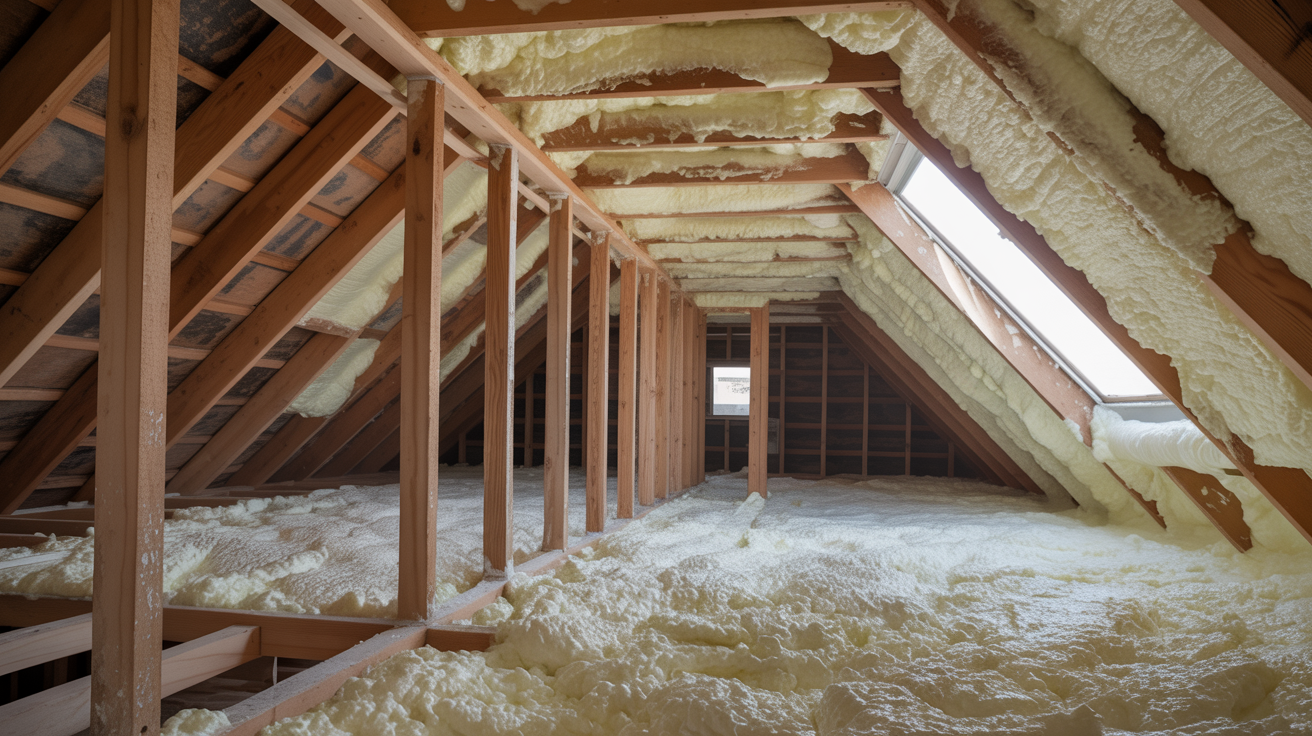
A significant portion of the housing stock in Springfield, Nixa, Ozark, Republic, and Marshfield was built decades before modern energy codes took effect. Homes constructed in the 1960s, 1970s, and even into the 1980s were often insulated with whatever was cheapest and most available at the time — typically thin batts of fiberglass stuffed between studs, with little attention paid to air sealing or thermal bridging. For the homeowners living in these houses today, the result is a familiar pattern: rooms that never quite reach a comfortable temperature, energy bills that seem disproportionately high, and drafts that persist no matter how many times the weatherstripping gets replaced.
Retrofitting spray foam insulation into an existing home is a fundamentally different challenge than insulating during new construction, and understanding those differences helps homeowners make smarter decisions about where to invest and what to expect.
Why Older Homes Underperform Thermally
Before diving into the retrofit process itself, it helps to understand why older homes struggle so much with thermal performance. The issue is rarely just the insulation material — it's the combination of inadequate insulation depth, missing air barriers, and decades of settling and shifting that create gaps and pathways for conditioned air to escape.
In Southwest Missouri's climate, where summer humidity regularly climbs above 70 percent and winter temperatures can drop into the single digits, those gaps matter enormously. Warm, moist outdoor air infiltrating through wall cavities in July can deposit moisture inside the structure, feeding mold and degrading whatever insulation remains. Cold air seeping through rim joists and attic bypasses in January forces heating systems to run longer and harder than they should. The hidden cost of poor insulation in these older homes compounds year after year, often totaling far more than homeowners realize.
The Retrofit Approach: Starting With an Audit
A successful spray foam retrofit begins not with a spray gun but with a careful assessment of the home's existing thermal envelope. A qualified contractor will evaluate the attic, crawl space or basement, rim joists, and wall cavities to identify where heat loss is greatest and where air infiltration is most severe. Thermal imaging and blower door testing can reveal leakage points that are invisible to the naked eye — gaps around recessed lights, unsealed top plates, and bypasses through interior wall cavities that connect conditioned space directly to the attic.
This diagnostic step is especially important in older homes because the building's quirks and modifications over the decades can create unexpected pathways. A 1970s ranch in Ozark that had a room addition in the 1990s, for example, may have a thermal boundary that doesn't align with the visible walls. Identifying these anomalies before spraying ensures the retrofit addresses the actual problem rather than just the most obvious one.
Attic Retrofits: The Highest-Impact Starting Point
For most older Missouri homes, the attic is the single most impactful place to begin a spray foam retrofit. Heat rises, and in a home with inadequate attic insulation, a substantial portion of the energy used to heat or cool the living space escapes directly through the ceiling. Older homes frequently have attic insulation that has settled, been disturbed by HVAC work, or simply never met modern performance standards to begin with.
There are two primary approaches to attic retrofits: insulating the attic floor (keeping the attic as an unconditioned space) or insulating the roofline to bring the attic inside the thermal envelope. The right choice depends on whether HVAC equipment and ductwork are located in the attic. If they are — which is common in homes built in the 1980s and 1990s — bringing the attic inside the conditioned envelope with closed-cell spray foam applied to the underside of the roof deck can dramatically reduce duct losses and improve overall system efficiency. If the attic is truly empty, a deep application of open-cell spray foam or a combination approach to the attic floor may be more cost-effective.
Understanding the distinction between open-cell and closed-cell products is important here. Open-cell vs. closed-cell spray foam each have specific performance characteristics that make them better suited to different applications within the same home.
Crawl Spaces and Basements in Retrofit Projects
Older homes in the Springfield area frequently have either a vented crawl space or an unfinished basement — and both present significant retrofit opportunities. Vented crawl spaces were standard practice for decades, based on the theory that ventilation would prevent moisture buildup. Building science has since demonstrated that in humid climates like Southwest Missouri's, vented crawl spaces often do the opposite: they draw in warm, moist outdoor air that condenses on cooler surfaces inside the crawl space, creating ideal conditions for mold growth and wood rot.
Encapsulating a crawl space with closed-cell spray foam applied to the foundation walls and rim joists — combined with a vapor barrier on the ground — converts it from a liability into a controlled environment. Homeowners who have made this change often report that their floors feel warmer in winter, their HVAC system runs less frequently, and musty odors that had persisted for years simply disappear. The relationship between crawl space conditions and crawl space condensation and mold risks is well-documented, and a retrofit that addresses the root cause rather than just the symptoms pays dividends for decades.
Rim joists — the band of framing that sits atop the foundation wall and supports the floor system — deserve special attention in any retrofit. They are among the most air-permeable parts of an older home's structure, and rim joists are often the biggest hidden energy leak in homes that otherwise appear well-insulated. A targeted application of closed-cell spray foam to the rim joist cavity is one of the most cost-effective improvements available in a retrofit project.
Wall Cavities: The Most Complex Retrofit Challenge
Retrofitting wall cavities in an existing home is the most technically demanding part of the process. Unlike attics and crawl spaces, which are generally accessible, wall cavities are enclosed by drywall on the interior and sheathing on the exterior. Adding spray foam to existing walls typically requires either drilling holes through the exterior cladding to inject foam into each stud bay, or removing and replacing interior drywall — a more disruptive but thorough approach.
For many older Missouri homes, the most practical strategy is to prioritize the attic, crawl space, and rim joists first, since these areas typically account for the majority of heat loss and air infiltration. Wall cavity work can be phased in during a renovation or siding replacement project, when access is naturally available. This staged approach allows homeowners to capture the largest efficiency gains immediately while planning for more comprehensive improvements over time.
What to Expect After a Retrofit
Homeowners who complete a well-executed spray foam retrofit in an older Missouri home typically notice several changes within the first heating or cooling season. The most immediate is a reduction in drafts and temperature variation between rooms — a problem that affects bedrooms on the same floor differently in many older homes with inconsistent insulation coverage. HVAC systems that previously ran almost continuously during peak weather often cycle less frequently, and energy bills reflect the difference.
Beyond comfort and cost, a properly air-sealed home also tends to have better indoor air quality. Older homes that drew in unfiltered outdoor air through gaps and cracks — bringing with them pollen, dust, and humidity — become more controlled environments after a retrofit. The HVAC system can manage ventilation intentionally rather than relying on random infiltration, which is particularly meaningful for households with allergy sufferers or respiratory sensitivities.
It's also worth noting that a spray foam retrofit can affect how an HVAC system performs and whether its current sizing remains appropriate. In some cases, a home that was previously losing so much conditioned air that it needed an oversized system may find that the existing equipment is now more than adequate — or that a smaller, more efficient unit would serve the tightened envelope better. Understanding how spray foam affects HVAC sizing is an important part of planning a comprehensive retrofit.
Planning a Retrofit in Southwest Missouri
For homeowners in Springfield, Nixa, Ozark, Republic, Marshfield, and the surrounding communities, the decision to retrofit spray foam insulation into an older home is ultimately a building science decision as much as a financial one. The climate in Southwest Missouri demands a thermal envelope that can handle both extremes — the oppressive humidity of August and the sharp cold of January — and older homes were simply not built to those standards.
The most effective approach is to work with a contractor who understands the building science of existing homes, not just the mechanics of applying foam. A thorough assessment, a clear prioritization of where improvements will have the greatest impact, and a realistic understanding of what the retrofit will and won't accomplish are the foundations of a project that delivers lasting results. For most older homes in this region, the question isn't whether a retrofit is worth doing — it's where to start.