
Why Bedrooms on the Same Floor Feel Completely Different
You adjust the thermostat to a comfortable 72 degrees, yet one bedroom feels perfect while another requires an extra blanket. Understanding why rooms sharing the same hallway experience such different temperatures reveals opportunities for meaningful comfort improvements.
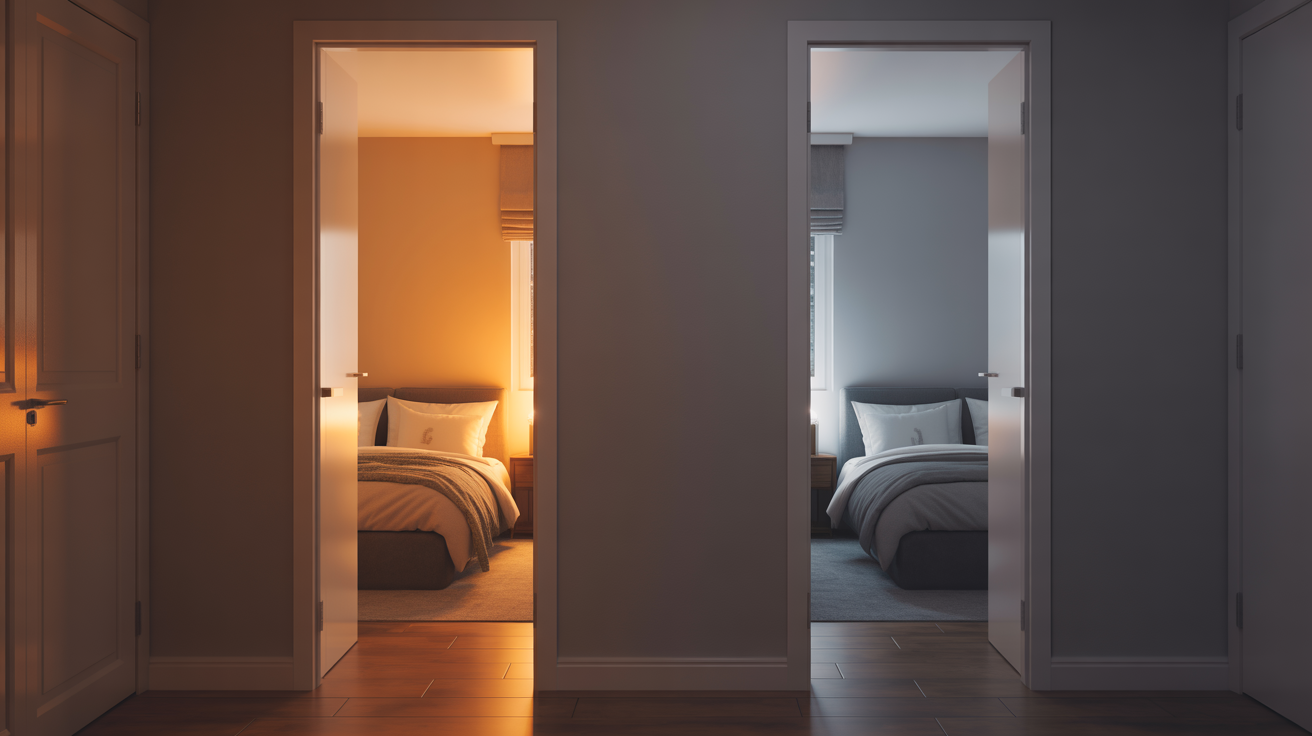
The thermostat reads 72 degrees, but your bedroom feels nothing like that number. Meanwhile, the guest room down the hall somehow maintains perfect sleeping temperature without any intervention. This frustrating inconsistency affects countless homes, leaving occupants wondering why rooms separated by just a few feet can feel worlds apart in comfort.
The explanation involves building science principles that most homeowners never encounter until temperature differences become impossible to ignore. What appears to be a simple case of adjusting the thermostat actually involves complex interactions between building envelope performance, air distribution systems, and the unique characteristics of each room's position within the overall structure.
The Thermostat Tells Only Part of the Story
A single thermostat measures temperature at one location—typically a central hallway or common area. That reading triggers heating or cooling cycles based on conditions at that specific spot, regardless of what temperatures individual bedrooms actually experience. The system responds to an average that may not represent any particular room's reality.
Bedrooms positioned near the thermostat tend to match its reading fairly closely. Rooms farther away, particularly those at the ends of hallways or in corners of the house, often experience temperatures several degrees different from what the thermostat displays. During heating season, these peripheral rooms may remain noticeably cooler. During cooling season, they often struggle to shed accumulated heat.
This spatial variation stems from fundamental limitations in how forced-air systems distribute conditioned air. The thermostat satisfies before peripheral rooms reach the desired temperature, shutting down equipment while those spaces still need conditioning. The cycle repeats constantly, with some bedrooms perpetually chasing comfort that arrives at the thermostat location but never quite reaches them.
Exterior Exposure Creates Thermal Inequality
Bedrooms rarely share identical relationships with the outside environment. Corner rooms feature two exterior walls rather than one. End-of-hall bedrooms may have three sides exposed to outdoor conditions. Interior bedrooms might have no direct exterior exposure at all. These differences in envelope contact dramatically affect how each space gains and loses heat.
Every square foot of exterior wall represents a pathway for thermal energy to move between inside and outside. Rooms with greater exterior exposure simply have more surface area through which heat transfers. During winter months, these bedrooms lose heat faster than interior rooms. Summer reverses the equation, with exterior walls conducting outdoor heat into spaces that the cooling system struggles to keep comfortable.
Window placement amplifies these differences. South-facing bedrooms gain substantial solar heat during winter afternoons—potentially welcome during heating season but problematic during summer months. North-facing rooms receive minimal direct sunlight year-round, maintaining cooler temperatures that feel pleasant in summer but require additional heating through winter. The same house can contain bedrooms that behave almost oppositely depending on their orientation.
As we've covered in our article about multi-story home comfort, similar principles create vertical temperature stratification between floors. Horizontal variation along the same floor follows parallel logic, with position relative to envelope exposure determining baseline thermal behavior.
Air Pathways Operating Behind Walls
Temperature differences between same-floor bedrooms often trace back to air movement that occurs entirely out of sight. The building envelope that separates conditioned space from the outdoors rarely achieves the continuity that blueprints suggest. Gaps, penetrations, and assembly joints create pathways for air exchange that affect some rooms far more than others.
Exterior corners concentrate multiple framing members where walls intersect. These junctions often feature gaps between components that allow outdoor air direct access to wall cavities. From there, air can travel significant distances through interconnected spaces within the building assembly, affecting rooms throughout the structure. Bedrooms at exterior corners face these concentrated infiltration points directly.
Ceiling planes present similar opportunities for air movement. Dropped soffits, tray ceilings, and changes in ceiling height create pathways connecting wall cavities to attic space. Bedrooms featuring such architectural details may experience air washing over insulation—currents of attic air that bypass thermal barriers entirely and carry heat directly into or out of wall assemblies.
Electrical penetrations, plumbing chases, and ductwork passages punch additional holes through the building envelope. The bedroom with the bathroom exhaust fan, the one with the cable TV wiring, or the room nearest the HVAC equipment closet may face more numerous penetrations than neighboring spaces. Each opening represents potential for air movement that undermines comfort in that specific room.
Ductwork Distribution and Airflow Balance
Forced-air systems deliver conditioned air through networks of supply ducts that rarely treat all rooms equally. Bedrooms closest to the air handler typically receive stronger airflow than rooms at the ends of extended duct runs. Pressure losses accumulate along ductwork, reducing the volume of conditioned air available to distant spaces.
Duct sizing compounds these distance effects. Systems designed to absolute minimums may provide adequate airflow under ideal conditions but fall short when filters accumulate debris or when dampers restrict portions of the system. Bedrooms served by undersized or excessively long duct runs bear the consequences of marginal design choices.
Return air pathways prove equally critical. Bedrooms with dedicated return air grilles draw conditioned air through the space effectively, creating circulation patterns that maintain uniform temperatures. Rooms depending on transfer through hallways or door undercuts may experience stagnant conditions where the same air recirculates without effective replacement. Closing bedroom doors worsens this imbalance, isolating spaces from the air circulation they need.
The comfort challenges this creates extend throughout the year. You can learn more about seasonal implications in our previous post on Missouri's humid summers, where inadequate air circulation allows humidity to accumulate in spaces that receive insufficient conditioned airflow.
Traditional Insulation Limitations
Standard fiberglass insulation provides thermal resistance but does nothing to address air movement. The fluffy batts that fill most wall and ceiling cavities slow conductive heat transfer reasonably well when perfectly installed but offer no barrier to air carrying heat through and around the insulation itself.
Installation quality varies dramatically between bedrooms in the same house. Walls with numerous electrical outlets may have insulation cut and pieced around boxes, creating gaps that reduce effective coverage. Exterior walls with plumbing may have insulation compressed or displaced to accommodate pipes. The bedroom with the cleanest framing geometry likely outperforms rooms where complications forced installation compromises.
Over decades, batt insulation in wall cavities can shift, settle, or compress, creating voids that allow convective air movement. Vertical cavities prove particularly susceptible to this degradation, with insulation slumping downward and leaving upper wall sections effectively uninsulated. Bedrooms in older homes often display these accumulated deficiencies more severely than newer construction.
The fundamental limitation remains: fiberglass addresses only one mechanism of heat transfer while ignoring the air movement responsible for significant comfort differences. A bedroom can have walls completely filled with batt insulation yet still experience temperatures several degrees different from neighboring rooms due to air infiltration that the insulation neither prevents nor addresses.
Achieving Consistent Room Temperatures
Spray foam insulation approaches bedroom comfort challenges differently by addressing both thermal resistance and air sealing simultaneously. The material expands to fill cavities completely, conforming to irregular framing geometry and sealing around penetrations that other insulation types cannot address.
Applied to exterior walls, spray foam eliminates the air washing that carries heat through and around conventional insulation. Corner assemblies, ceiling transitions, and penetration surrounds all receive continuous coverage that maintains the building envelope's integrity. The differential exposure that makes some bedrooms challenging still exists, but the envelope performs consistently regardless of room position.
Interior partition walls between bedrooms and adjacent spaces benefit from spray foam's acoustic properties. Sound transmission that disrupts sleep in one bedroom while leaving another quiet often follows the same pathways that allow thermal communication between spaces. Addressing air sealing between rooms reduces both noise transfer and temperature bleed between adjacent areas.
As explained in our guide on professional installation, proper application requires attention to detail that ensures every bedroom receives equivalent treatment. The systematic approach professional installers employ eliminates the room-to-room variation in installation quality that undermines comfort consistency in conventionally insulated homes.
Beyond Temperature to Quality Rest
Bedroom comfort encompasses more than thermometer readings. Sleep quality depends on stable temperatures that allow the body's natural temperature regulation to function without fighting environmental swings. Rooms that heat up during afternoon sun and cool dramatically overnight create conditions where restful sleep proves elusive regardless of average temperature.
Consistent temperatures throughout the night allow deeper, more restorative sleep cycles. Bedrooms properly insulated and sealed maintain stable conditions from evening through morning, supporting the uninterrupted rest that benefits health and daily function. The difference between sleeping in a thermally stable room and one that fluctuates significantly affects how occupants feel throughout the following day.
Addressing bedroom temperature consistency represents investment in daily quality of life—the hours spent sleeping in comfortable conditions that support genuine rest. Understanding why same-floor bedrooms experience different temperatures reveals that the problem has solutions. Proper air sealing and insulation can transform problematic bedrooms into spaces that deliver the comfort their occupants deserve, supporting better sleep, more consistent energy costs, and whole-house performance that finally matches the thermostat's promise.