
Why Moisture Problems Often Start in Hidden Structural Areas
Moisture damage rarely announces itself. It begins quietly inside wall cavities, attic framing, and subfloor assemblies—long before stains or odors appear. Understanding where and why moisture accumulates helps homeowners protect their homes before costly damage sets in.
Why Moisture Problems Often Start in Hidden Structural Areas
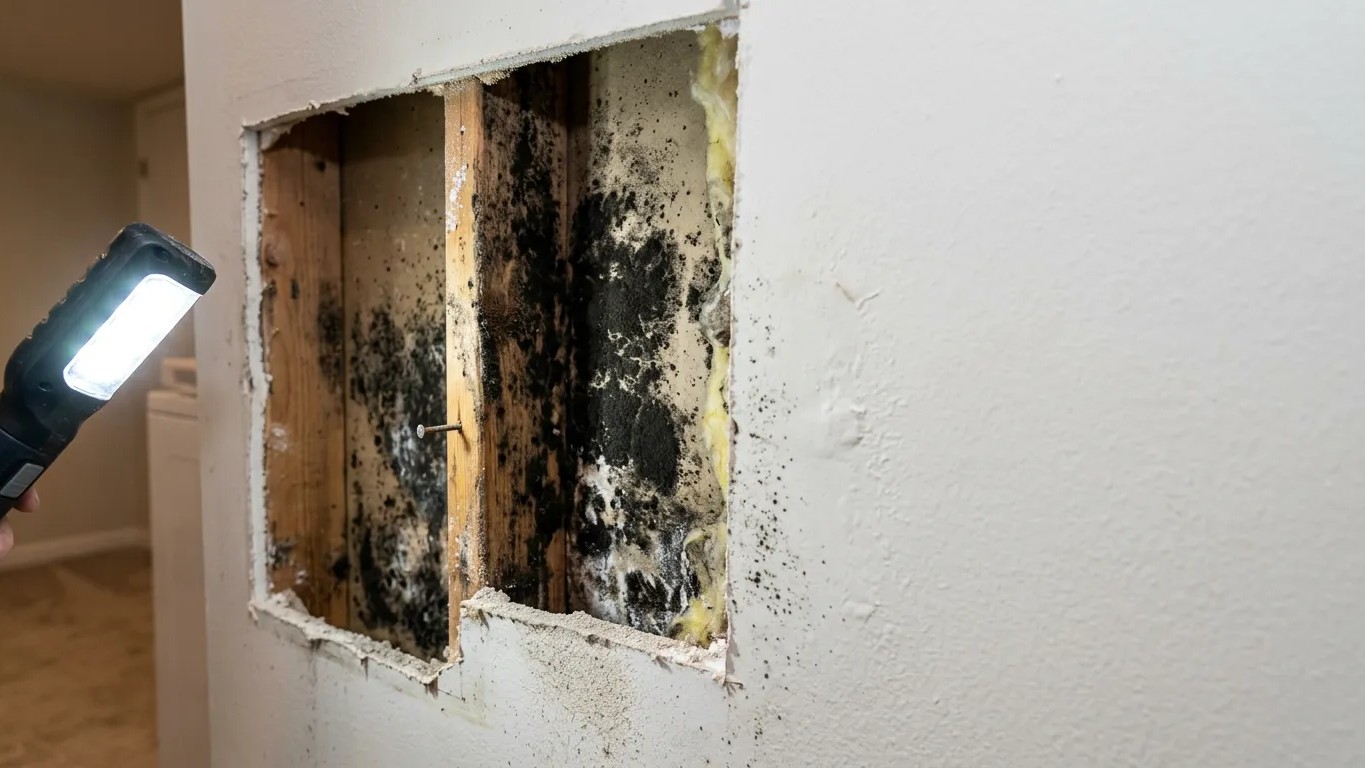
Most homeowners discover moisture damage only after it has progressed far enough to leave visible evidence—a discolored ceiling, a musty smell in a hallway, soft drywall that yields under light pressure. By the time these signs appear, the underlying problem has often been developing for months or even years in places no one thought to inspect. The water stain on the ceiling is not the beginning of the problem. It is the moment the problem finally ran out of room to hide.
Understanding how moisture behaves inside a building's structure explains why so many issues originate in concealed spaces. It also clarifies why certain approaches to insulation and air sealing succeed at preventing these problems while others leave homes vulnerable despite appearing adequate on the surface.
How Moisture Enters Structural Cavities
Water in its liquid form is relatively easy to manage. Roofs shed rain, gutters channel it away, and flashing directs it around penetrations. Homeowners generally understand these systems because the water is visible and its behavior is intuitive. The moisture that causes hidden structural damage, however, usually arrives in a far less obvious form—as water vapor carried by moving air.
Indoor air contains moisture generated by cooking, bathing, breathing, and dozens of other daily activities. That moisture-laden air doesn't stay put. It moves through the building driven by pressure differences, temperature gradients, and mechanical systems. Every gap in the building envelope—around electrical outlets, plumbing penetrations, recessed lights, top plates of interior walls, and joints between framing members—provides a pathway for this air to travel into spaces where it doesn't belong.
Once warm, humid air enters a wall cavity or reaches the underside of roof sheathing, it encounters surfaces that are cooler than the air itself. Physics takes over from there. The air's capacity to hold moisture drops as it cools, and the excess water condenses on the nearest available surface. This is the same process that forms droplets on a cold glass in summer, except it happens inside a wall where no one can see it occurring.
The Role of Temperature Differences in Moisture Accumulation
Condensation requires a temperature differential, and buildings provide that differential constantly. In winter, the warm interior and cold exterior create a gradient across every wall, ceiling, and floor assembly that separates conditioned space from the outdoors. The inside surface of exterior sheathing can be well below the dew point of the indoor air that reaches it. Moisture condenses there and saturates the surrounding materials—wood framing, paper-faced insulation, and structural panels that were never designed for prolonged contact with water.
Summer reverses the equation but doesn't eliminate the risk. Hot, humid outdoor air can condense on cool interior surfaces, particularly in air-conditioned homes where wall cavities sit between warm exteriors and cooled interiors. In Missouri's climate, where summers combine sustained heat with heavy humidity, this warm-season condensation adds a second seasonal threat to the same structural components already stressed during winter. We've covered the particular demands of this regional climate in our article about why spray foam performs well during Missouri's humid summers.
The areas most vulnerable to condensation share a common trait: they sit at the boundary between conditioned and unconditioned space, where the temperature difference is greatest and air movement is most likely to deliver moisture.
Where Hidden Moisture Problems Develop
Certain structural areas are disproportionately prone to moisture accumulation because of how they're constructed and where they fall within the building envelope.
Attic spaces rank among the most common sites for hidden moisture trouble. Warm air rising through the building finds its way into the attic through ceiling penetrations, recessed light housings, and gaps around ductwork. When that air reaches the cold underside of the roof deck in winter, condensation forms on the sheathing. Over successive cycles of freezing and thawing, the plywood or OSB absorbs enough moisture to support fungal growth, compromise its structural integrity, and eventually telegraph damage through to the finished ceiling below.
Wall cavities present a different version of the same problem. Exterior walls contain dozens of penetrations—electrical boxes, pipe runs, window framing, and connections between floors—that allow air to migrate through the assembly. Traditional insulation placed between studs does nothing to stop this airflow. Fiberglass batts, in particular, are air-permeable by design. They slow conductive heat transfer but allow moisture-carrying air to pass through freely. The result is condensation forming on the back side of exterior sheathing, hidden behind drywall where it accumulates undetected. We've examined the broader financial consequences of these overlooked failures in our discussion of the hidden costs homeowners rarely calculate.
Rim joist areas—the perimeter band where floor framing meets the foundation wall—are particularly susceptible. These zones are notoriously difficult to seal and insulate properly. They combine multiple materials, irregular geometry, and direct exposure to exterior conditions. Moisture that condenses here can damage floor framing and subflooring from below, creating problems that eventually manifest as soft spots, squeaky floors, or unexplained odors at the base of walls.
Crawl spaces and subfloor assemblies face moisture pressure from both directions. Ground moisture migrates upward through exposed soil or inadequately sealed vapor barriers, while conditioned air from above leaks downward through floor penetrations. The crawl space becomes a reservoir of humidity that bathes the underside of the floor structure in moisture, promoting wood decay and creating conditions favorable to pest activity.
Why Conventional Insulation Falls Short Against Moisture
The fundamental limitation of traditional insulation materials in preventing moisture problems is that they address only one half of the equation. Fiberglass batts and loose-fill cellulose resist conductive heat transfer—they slow the movement of thermal energy through the material itself. But they do not create an air barrier, and it is air movement, not conduction, that delivers the vast majority of moisture into structural cavities.
A wall insulated with fiberglass can have an adequate R-value on paper while still allowing enough air leakage to deposit meaningful quantities of moisture on cold surfaces within the assembly. The insulation fills the cavity but doesn't seal it. Air moves around the edges of batts, through gaps at the top and bottom plates, and through the insulation itself. Each of these pathways carries water vapor into precisely the locations where condensation is most likely.
This distinction between thermal resistance and air sealing is central to understanding why some well-insulated homes still develop moisture problems. The insulation is performing its thermal function while failing entirely at moisture control because it was never designed to stop air movement. It's a gap that many homeowners don't recognize until damage has already occurred.
How Spray Foam Addresses Moisture at Its Origin
Spray foam insulation takes a fundamentally different approach to the moisture challenge. Rather than filling a cavity with a permeable material and hoping that air finds no pathway through, spray foam bonds to the surrounding surfaces and expands to seal every gap, crack, and irregularity in the assembly. The result is a continuous barrier that stops both heat transfer and air movement simultaneously.
This dual function is what distinguishes spray foam from every other residential insulation option when it comes to moisture prevention. By eliminating the air pathways that deliver moisture into structural cavities, spray foam removes the mechanism that causes condensation in the first place. Warm, humid air simply cannot reach the cold surfaces where it would otherwise deposit its moisture content.
Closed-cell spray foam adds another layer of protection. Its dense, closed cellular structure resists moisture absorption, meaning that even if some incidental moisture contacts the foam, it doesn't saturate the material or pass through to the surfaces behind it. This characteristic is particularly valuable in rim joist applications, crawl space ceilings, and other areas where moisture exposure is persistent and insulation materials need to withstand humid conditions indefinitely.
The permanence of this protection matters as much as its effectiveness. Unlike fibrous materials that can settle, compress, or shift over time—opening gaps that re-establish air leakage pathways—spray foam maintains its position and performance characteristics for the life of the structure. As we've explained in our article on how long spray foam insulation lasts in Missouri homes, this durability means the moisture protection installed today continues functioning decades from now without maintenance or replacement.
The Consequences of Leaving Moisture Unchecked
Hidden moisture accumulation doesn't resolve itself. Left unaddressed, it follows a predictable progression. Wood framing absorbs water and begins to lose structural strength. Sheathing panels delaminate. Metal fasteners corrode. Organic materials support microbial growth that spreads through connected cavities. Over time, what began as invisible condensation on a cold surface becomes a problem that requires tearing out finished surfaces, replacing damaged framing, and rebuilding portions of the structure.
The financial cost of remediation typically dwarfs the cost of prevention. Replacing rotted rim joists, remediating affected wall cavities, or rebuilding deteriorated roof sheathing involves not just materials and labor but also the disruption of removing and reinstalling finished surfaces, fixtures, and sometimes mechanical systems. Understanding this trajectory reinforces why addressing the root cause—air leakage carrying moisture into hidden spaces—is far more practical than waiting to address the consequences.
Prevention Through Proper Air Sealing and Insulation
Moisture problems in hidden structural areas are not inevitable. They follow predictable patterns driven by air movement, temperature differentials, and the properties of the materials involved. Homeowners who understand these patterns can make informed decisions about how to protect their homes before damage begins rather than reacting after it surfaces.
The most effective prevention strategy combines thermal insulation with comprehensive air sealing—stopping both heat transfer and the air movement that carries moisture. For homeowners considering how to approach this, we've outlined what to expect during a professional spray foam installation and discussed what makes this approach a sound long-term investment.
Addressing air leakage and insulation performance at the structural level protects the materials that hold a home together. It's a quieter form of home improvement than a kitchen remodel or a new roof, but for the longevity of the building itself, few upgrades carry more lasting significance.