
Spray Foam for Metal Buildings: Stopping Condensation Drip in Missouri Shops and Barns
Spray foam for metal buildings stops condensation drip in Missouri shops and barns. See how closed-cell foam seals steel roofs and walls against sweating.
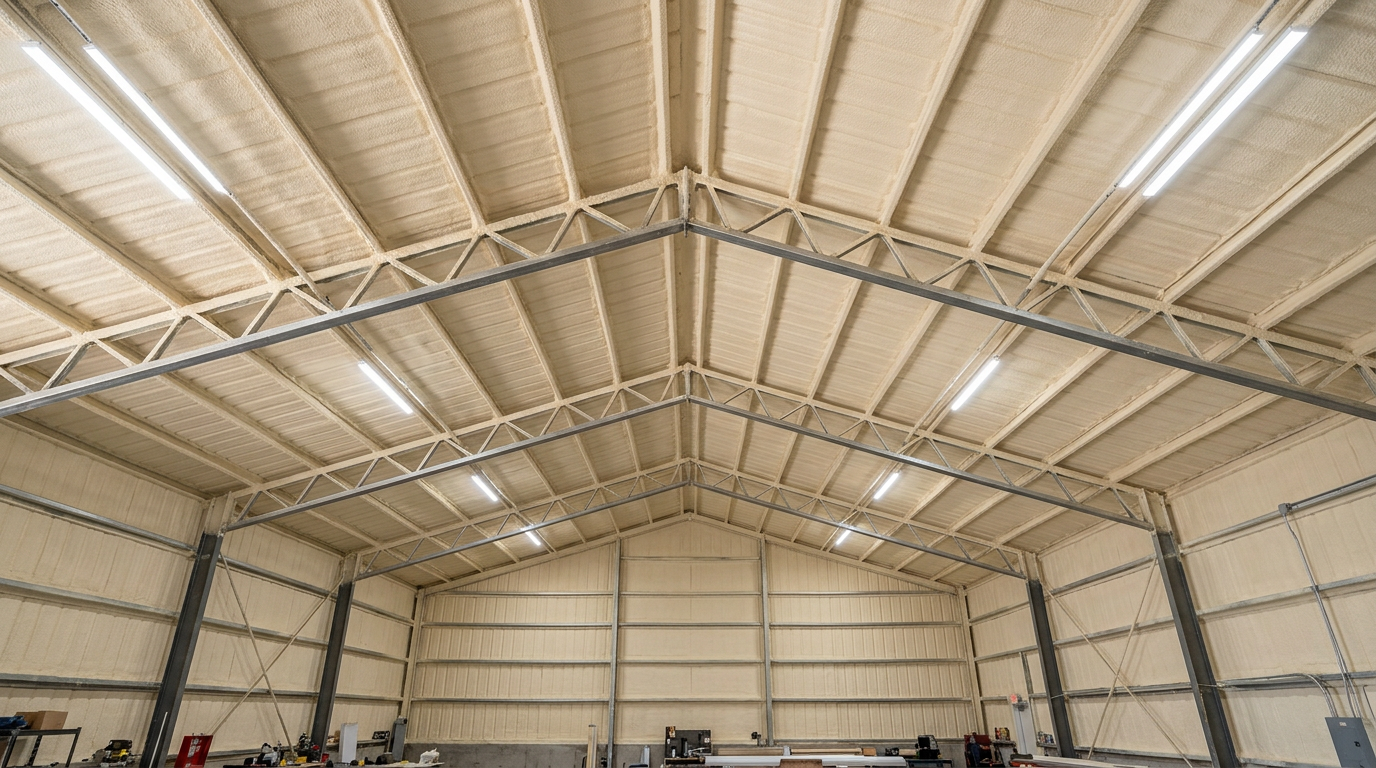
Spray Foam for Metal Buildings: Stopping Condensation Drip in Missouri Shops and Barns
Spray foam for metal buildings stops condensation by sealing the steel from the humid air that makes it sweat. Applied to the underside of the roof deck and walls, closed-cell foam holds the metal above the dew point so the drips that rust tools, soak hay, and stain finished floors never get a chance to form.
Why Metal Buildings Sweat in the First Place
A bare steel panel is one of the fastest-cooling surfaces on any job site. On a clear Missouri night, the metal radiates its heat to the sky and drops several degrees below the surrounding air. When warm, moist air inside the building touches that cold steel, the water vapor it carries condenses into liquid, the same way a glass of iced tea beads up on a July afternoon.
In an uninsulated shop or barn, that moisture collects on the underside of the roof and then falls. People call it a roof leak and climb up looking for a hole that is not there. The water is not coming through the roof. It is coming out of the air inside the building, and it will keep coming back every time the temperature swings, which in Southwest Missouri is most of the year.
Two things make our region especially hard on metal buildings. Our summers are humid, so the air inside a shop holds a lot of vapor. Our shoulder seasons in spring and fall bring wide day-to-night temperature swings, which is exactly the condition that drives condensation. A pole barn in Nixa or a machine shop in Republic can drip for weeks in October without a single drop of rain falling.
What Condensation Costs You in a Missouri Shop or Barn
Sweating steel is not just a nuisance. Over a few seasons it does real damage that shows up on your repair bills.
Rust and corrosion: constant moisture attacks fasteners, purlins, and any bare steel it lands on, shortening the life of the building itself.
Ruined contents: condensation drips onto table saws, welders, stored equipment, feed, and hay. Wet hay can heat and spoil, and rust on tools is money off the top.
Mold and rot: if the building has any wood framing, sheathing, or a finished ceiling, repeated wetting invites mold and eventually rot.
Slick, unusable floors: water pooling on a concrete shop floor is both a slip hazard and a sign the moisture problem is only getting worse.
Poor comfort and high bills: the same uninsulated shell that sweats also lets your heat pour out in winter and bakes you in summer.
How Spray Foam for Metal Buildings Stops the Drip
Spray foam is the most reliable fix because it attacks condensation at the cause instead of trying to manage the symptom. When we install closed-cell spray foam directly against the underside of the metal roof and walls, it does two jobs at once.
First, it insulates. The foam keeps the steel much closer to the temperature of the air inside the building, so the panel no longer drops below the dew point. If the metal never gets cold enough to condense moisture, it never sweats.
Second, it air seals. Closed-cell foam expands into every seam, lap, and fastener penetration and cures into a rigid, continuous layer. That stops humid outdoor air from washing across the back of the panel and stops the indoor air movement that feeds condensation. Because it bonds tightly to the steel, there is no gap behind the insulation where moist air can sneak in and reach a cold surface, which is the exact failure mode that makes batt insulation and loose vinyl-backed blankets drip in metal buildings.
Closed-cell foam also earns its place here because it is recognized as a Class II vapor retarder, so it controls how water vapor moves through the assembly rather than letting it collect against the steel. Sealing the shell tighter also cuts the load on any heater or cooler you run in the space, which is where the up to 40 percent energy savings spray foam is known for comes from.
For a full walkthrough of how we approach steel and post-frame structures, see our pole barn and shop insulation service page, and our post on why spray foam is ideal for pole barns, workshops, and outbuildings.
Closed-Cell vs Open-Cell in a Steel Building
We install both types of foam, but for metal buildings the choice is usually straightforward. Here is how the two compare for this specific use.
Closed-cell spray foam: dense and rigid, higher R-value per inch, resists liquid water, and acts as a Class II vapor retarder. It bonds hard to steel, adds a measure of rigidity to the panel, and is the type we reach for first on roofs and walls of shops, barns, and barndominiums where condensation control is the whole point.
Open-cell spray foam: lighter and softer, excellent at air sealing and sound control, and lower in cost per square foot. It is a good fit for interior partition walls or a conditioned barndominium living area, but on its own it is not the right vapor control layer against bare exterior steel in our climate.
For most Missouri metal buildings that are fighting a drip problem, closed-cell foam on the roof and exterior walls is the answer. If you want the deeper comparison for a home, our guide on open-cell versus closed-cell spray foam for Missouri homes breaks it down further.
What the Job Looks Like on a Pole Barn or Steel Frame
Every building is a little different, but the process follows the same shape. We start by looking at how the building is used, whether it is heated or cooled, and where the moisture and drafts are worst. We check that the steel is clean and dry enough for the foam to bond, because adhesion is everything on a metal surface.
From there we spray closed-cell foam in even lifts across the roof deck and walls, working around purlins, girts, wiring, and any penetrations so the seal stays continuous. Because the foam expands and cures in place, it follows the ribs and laps of the panel instead of leaving the air gaps that cause blanket insulation to fail.
Most straightforward shop and barn jobs move quickly once we are set up, on a similar footing to the one to two day timeline most residential jobs run. Larger or more complicated steel buildings take longer, and we will give you a realistic schedule when we quote the work rather than a number pulled from thin air.
Retrofit or New Construction
You do not have to catch this at build time. We regularly spray existing metal buildings that have been dripping for years, and the fix works just as well on a ten-year-old shop as it does on new steel, as long as the surface is sound and we can get access to the roof and walls. If you are still in the planning stage on a new shop, barn, or barndominium, insulating during construction is the cleanest path and worth building into the budget from the start. Our complete guide to spray foam for attics, crawl spaces, and metal buildings covers how the same principles apply across the whole envelope.
Frequently Asked Questions
Does spray foam really stop condensation in an uninsulated metal building?
Yes, when it is the right type installed correctly. Closed-cell foam keeps the steel warm enough that indoor humidity no longer condenses on it, and it seals the air paths that feed the problem. Because it removes the cause rather than catching the drips, it is a permanent fix, not a patch.
Can you spray foam an existing metal building, or only during construction?
Both. We insulate existing shops, barns, and pole buildings all the time, and we also spray new steel during construction. The main requirement on a retrofit is that the metal is clean and dry enough for the foam to bond, which we confirm before we start.
How long does a spray foam job take on a shop or barn?
It depends on the size of the building and how much prep the steel needs. Many smaller shops and barns are handled on a timeline close to the one to two days most homes take, while larger steel buildings run longer. We give you a specific schedule with your written estimate.
Bottom line: In a Missouri metal building, the drip is condensation, not a leak, and closed-cell spray foam is the fix because it keeps the steel above the dew point and seals the air that carries the moisture. Whether your shop or barn is brand new or has been sweating for years, we can insulate it so it stays dry, comfortable, and cheaper to heat and cool.