
Vented vs. Unvented Attics: A Missouri Homeowner's Guide
Learn how vented and unvented attic assemblies perform in Missouri's humid climate and why spray foam is key to energy efficiency and moisture control.
Vented vs. Unvented Attics: A Missouri Homeowner's Guide
If you've ever climbed into your attic on a July afternoon in Springfield and felt like you'd stepped into an oven, you've experienced firsthand what building scientists call a "vented attic assembly" under stress. Missouri's climate — with its sweltering, humid summers, unpredictable spring storms, and sharp freeze-thaw cycles in winter — puts attic assemblies through a punishing range of conditions. Understanding the difference between vented and unvented attic designs isn't just academic; it directly affects your home's energy performance, moisture durability, and long-term comfort.
What Is a Vented Attic Assembly?
A vented attic is the traditional approach most Missouri homes were built with. In this design, insulation sits on the attic floor (the ceiling of your living space below), and the attic space itself is ventilated to the outside through soffit vents, ridge vents, gable vents, or some combination of all three. The idea is to keep the attic close to outdoor temperature and humidity levels, which theoretically prevents moisture from accumulating on cold roof sheathing in winter and reduces heat buildup in summer.
In theory, this works reasonably well in dry climates. In practice, Southwest Missouri's humidity complicates things considerably. During spring and early summer, warm, moist outdoor air flows freely into a vented attic. When that humid air contacts cooler surfaces — roof sheathing, rafters, or even the top of your insulation — condensation can form. Over time, this moisture feeds mold growth and wood rot in the very structural members holding up your roof. If you've noticed musty odors or dark staining on attic framing, this moisture cycle is often the culprit.
Vented attics also create a significant thermal penalty. Even with R-38 or R-49 insulation on the attic floor, the ductwork and air handler units that many Missouri homes run through the attic are sitting in an unconditioned space that can reach 140°F or higher in August. Ducts that leak even slightly in that environment are dumping conditioned air into a superheated void — a problem explored in depth when looking at how spray foam affects HVAC sizing in Missouri homes.
What Is an Unvented (Hot Roof) Attic Assembly?
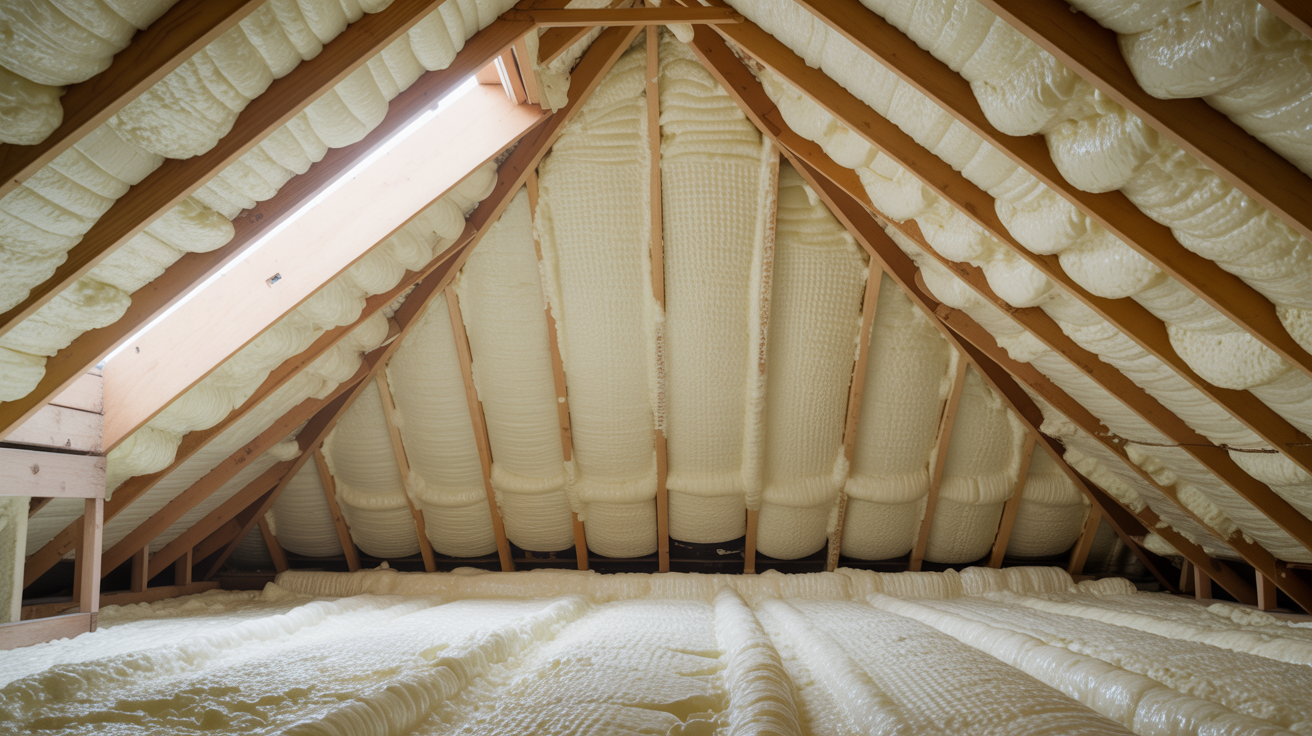
An unvented attic — sometimes called a "hot roof" or "conditioned attic" — moves the insulation layer from the attic floor up to the roofline itself. Instead of ventilating the attic to the outside, the space is sealed and brought inside the home's thermal envelope. Spray foam insulation applied directly to the underside of the roof sheathing is the most common and effective way to create this assembly.
In an unvented attic, the attic space stays close to the temperature of your living area. Ductwork and mechanical equipment in the attic are no longer exposed to extreme heat or cold. The roof sheathing stays warmer in winter, which eliminates the cold surface that causes condensation. And because humid outdoor air can't freely enter the space, the moisture cycling that damages vented attics simply doesn't occur.
This approach aligns well with Missouri's climate challenges. The same humid air that causes problems in a vented attic is kept outside entirely. Homeowners who have struggled with crawl space condensation and mold risks will recognize the same principle at work — controlling where the moisture boundary sits is the key to preventing damage.
The Building Science Behind the Choice
The decision between vented and unvented isn't purely about preference — it's about physics. In a vented attic, the thermal boundary (where insulation lives) and the moisture boundary (where vapor diffusion slows) are both at the attic floor. This works when the attic above stays dry, but Missouri's climate makes that assumption unreliable.
In an unvented assembly with spray foam at the roofline, closed-cell spray foam acts as both an air barrier and a vapor retarder simultaneously. It stops air movement (which carries most moisture) and slows vapor diffusion. Open-cell spray foam can also be used in unvented assemblies, though it typically requires a vapor retarder on the interior side in cold climates — something a qualified installer will assess based on your specific roof geometry and climate zone. For a deeper look at how these two foam types compare, open-cell vs. closed-cell spray foam for Missouri homes covers the tradeoffs in detail.
One important consideration: unvented assemblies must be designed correctly. Trapping moisture inside an unvented attic without adequate vapor control can cause the same problems you were trying to avoid. This is why the choice of insulation material and thickness matters enormously, and why this work should be done by contractors familiar with Missouri's mixed-humid climate zone (Zone 4A).
Energy Performance Differences in Missouri's Climate
The energy performance gap between vented and unvented attics becomes most apparent during Missouri's extremes. In summer, a conditioned attic keeps duct systems in a space that might be 75°F rather than 140°F — a difference that dramatically reduces duct heat gain and allows your HVAC system to deliver conditioned air more efficiently. Homeowners often report that their air conditioning runs less frequently and their upstairs rooms feel more consistently comfortable after converting to an unvented assembly.
In winter, the benefits shift toward air sealing. Vented attics are notorious for allowing cold air to infiltrate through ceiling penetrations — recessed lights, plumbing chases, attic hatches, and framing gaps. These pathways let warm interior air escape and cold air enter, driving up heating costs and creating the cold floors and drafty rooms that many Missouri homeowners accept as normal. Understanding why rim joists are your home's biggest hidden energy leak reveals a similar pattern: the building envelope has multiple weak points, and the attic is often the largest one.
The freeze-thaw cycles that hit the Springfield area from November through March also stress vented attic assemblies. Temperature swings cause wood framing to expand and contract, gradually widening gaps that allow more air movement. An unvented assembly with spray foam applied directly to the sheathing moves with the structure and maintains its air seal through these cycles.
When a Vented Attic Still Makes Sense
Unvented assemblies aren't universally superior for every situation. Vented attics remain appropriate when ductwork and mechanical equipment are located entirely within the conditioned living space (not in the attic), when the roof geometry makes spray foam application impractical, or when budget constraints make a phased approach necessary. In these cases, maximizing insulation depth on the attic floor and carefully air-sealing all ceiling penetrations can still deliver meaningful improvements.
Homes with metal roofing or certain tile systems may also have manufacturer requirements that affect ventilation choices. A building professional familiar with Missouri's climate and local code requirements can evaluate your specific roof assembly before recommending a path forward.
It's also worth noting that converting a vented attic to an unvented assembly is a significant project — not a DIY undertaking. The work involves removing or blocking existing ventilation, applying spray foam to the entire roofline, and potentially relocating or resealing ductwork. For homeowners considering this as part of a broader energy upgrade, what makes spray foam a long-term investment provides useful context for evaluating the return on that investment.
Practical Guidance for Missouri Homeowners
If you're evaluating your attic assembly, start with a visual inspection. Look for dark staining on roof sheathing or rafters (a sign of past or ongoing moisture), check whether your HVAC equipment and ductwork are located in the attic, and note whether your attic floor insulation has gaps or compressed areas. These observations will help frame a productive conversation with an insulation contractor.
Ask any contractor you consult whether they have experience with unvented attic assemblies in Missouri's climate zone. Request that they explain their approach to vapor control and how they'll handle existing ventilation openings. A contractor who can speak fluently about building science — not just product specs — is more likely to deliver an assembly that performs well for decades.
Finally, consider the timing. Spring and early summer, before Missouri's heat peaks, is an ideal window for attic work. Temperatures are more manageable for installers, and completing the project before peak cooling season means you'll see the energy benefits immediately. Whether you're upgrading an existing vented attic or specifying an assembly for new construction, understanding the principles behind the choice puts you in a much stronger position to make a decision that serves your home well.