
Insulating Basements for Comfort, Energy Efficiency, and Moisture Control
Basements present unique insulation challenges that differ dramatically from upper floors. Learn why below-grade spaces feel cold and damp, how moisture migration affects your home, and why spray foam insulation delivers lasting comfort and protection where traditional materials fall short.
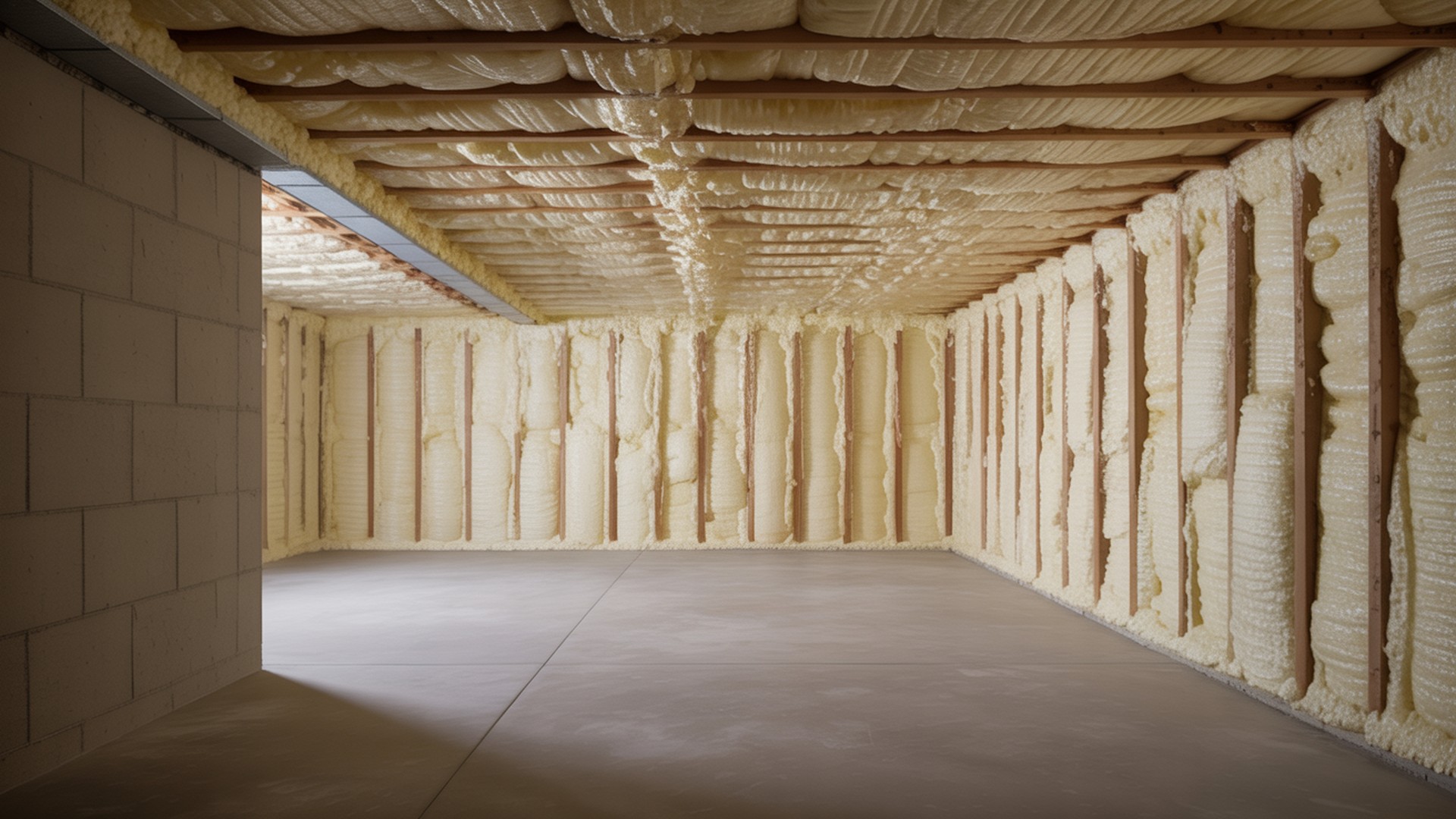
Basements occupy a peculiar position in residential construction. Surrounded by earth on multiple sides and separated from the living space above, they operate under environmental rules that differ dramatically from every other room in your home. Understanding these differences is essential for anyone hoping to transform a cold, clammy basement into a comfortable, energy-efficient extension of their living space.
Why Basements Behave Differently Than Upper Floors
The fundamental challenge with basements begins with their relationship to the surrounding soil. While upper floors interact primarily with outdoor air temperatures, basements are influenced by ground temperatures that remain relatively stable throughout the year—typically between 50 and 55 degrees in Missouri. This sounds like an advantage until you realize that your basement walls are constantly conducting heat away from the interior, creating a perpetual cooling effect that makes the space feel uncomfortable regardless of how warm you keep the rest of your home.
Air movement patterns compound this issue. Warm air naturally rises, which means heated air from your basement continuously migrates upward into the main living areas. Cooler air then descends to replace it, creating a convective loop that draws conditioned air out of the basement and pulls unconditioned air in through any available gap or crack. This constant air exchange makes temperature regulation extraordinarily difficult and places continuous strain on your heating system.
The rim joist area—where your foundation walls meet the floor framing of the level above—represents one of the most significant thermal weak points in residential construction. This junction typically contains numerous gaps around floor joists, sill plates, and utility penetrations. Cold air infiltrates through these openings, cooling the floor above and creating uncomfortable drafts that homeowners often feel but struggle to identify.
The Moisture Challenge in Below-Grade Spaces
Moisture behavior in basements follows patterns that seem almost counterintuitive to many homeowners. Water vapor naturally moves from areas of higher concentration to lower concentration, and from warmer areas to cooler ones. During summer months, warm humid outdoor air enters the basement through windows, doors, and air leaks. When this moisture-laden air contacts the cooler concrete walls, condensation forms—the same phenomenon that causes a cold glass of water to sweat on a humid day.
This process, called moisture migration, occurs continuously in below-grade spaces. Even concrete itself absorbs and releases moisture from the surrounding soil. Concrete is far more porous than it appears, and water vapor passes through foundation walls at a rate that surprises most homeowners. This ongoing moisture transfer creates the damp, musty conditions that make many basements feel inhospitable.
The consequences extend beyond simple discomfort. Persistent moisture encourages mold growth, degrades building materials, damages stored belongings, and can even affect the structural integrity of floor joists and sill plates over time. As we've covered in more detail in our article about how spray foam improves indoor air quality, controlling moisture at its source is essential for maintaining a healthy home environment.
Why Traditional Insulation Struggles in Basements
Fiberglass batts and other fibrous insulation materials face fundamental limitations when installed in basement environments. These materials were designed to slow heat transfer through air-permeable assemblies—they work by trapping still air within their fibers. However, they provide virtually no resistance to air movement or moisture migration, the two primary challenges in below-grade applications.
When fiberglass insulation is installed against concrete walls, moisture vapor passes directly through the material and condenses on the cold concrete surface behind it. This trapped moisture saturates the insulation, dramatically reducing its thermal performance. Wet fiberglass provides almost no insulating value and creates ideal conditions for mold growth hidden behind finished walls. Many homeowners have discovered this problem only after noticing musty odors or visible mold spreading across basement finishing materials.
Even properly installed fiberglass cannot address air leakage through rim joists and foundation penetrations. Air moves freely through fibrous insulation, which means cold drafts continue infiltrating the space regardless of how much insulation is present. This is why many homeowners with insulated basements still complain about cold floors, uncomfortable temperatures, and high energy bills.
Rigid foam board insulation offers better moisture resistance than fiberglass, but installation challenges often compromise its effectiveness. Achieving an airtight seal with rigid foam requires meticulous attention to every joint, seam, and penetration. In practice, gaps almost always remain, allowing air and moisture to bypass the insulation entirely. These installation imperfections accumulate over time as building materials expand, contract, and settle.
How Spray Foam Transforms Basement Performance
Spray foam insulation addresses basement challenges through a fundamentally different approach. Rather than simply filling cavities with insulating material, spray foam expands upon application to create a continuous, monolithic barrier that seals against air movement and moisture migration simultaneously. This dual function makes it uniquely suited for below-grade environments where both factors contribute to discomfort and energy waste.
Closed-cell spray foam, in particular, offers exceptional performance in basement applications. Its dense cellular structure creates an effective vapor retarder that prevents moisture from passing through the insulation and condensing on cold surfaces. This eliminates the moisture accumulation problems that plague fibrous insulation and dramatically reduces the risk of mold growth within wall assemblies.
The air-sealing capability of spray foam proves equally important. When applied to rim joists, foundation walls, and around utility penetrations, spray foam expands to fill every gap and irregularity in the substrate. This creates an airtight envelope that stops cold air infiltration and prevents warm conditioned air from escaping through the countless small openings that exist in typical foundation construction.
As explained in our guide on professional spray foam installation, trained technicians apply the material in carefully controlled layers to achieve optimal thickness and adhesion. The result is a seamless insulation system that conforms precisely to the unique geometry of each basement, addressing thermal bridging and air leakage points that would be impossible to seal effectively with other materials.
Addressing the Rim Joist: The Critical Connection Point
The rim joist area deserves special attention in any basement insulation project. This zone typically accounts for a disproportionate share of heat loss and air infiltration in residential buildings. Cold air entering through rim joist gaps doesn't just affect basement comfort—it cools the floor directly above, creating cold spots in first-floor rooms that many homeowners mistakenly attribute to window drafts or inadequate heating.
Spray foam application to rim joists creates an immediate and noticeable improvement in both basement and first-floor comfort. The material fills the complex geometry around floor joists, sill plates, and band boards completely, eliminating the infiltration pathways that traditional insulation cannot address. Homeowners frequently report that cold floor problems disappear entirely after rim joist treatment, even without insulating the remainder of the basement walls.
This targeted approach also provides excellent value for homeowners working within budget constraints. Rim joist insulation delivers substantial comfort and efficiency improvements at relatively modest cost, making it an ideal starting point for phased basement insulation projects.
Long-Term Performance and Durability
Unlike fibrous insulation materials that can settle, compress, or absorb moisture over time, properly installed spray foam maintains its performance indefinitely. The cured material does not sag or shift, and its closed-cell structure remains impervious to moisture regardless of conditions. This durability translates to consistent energy savings and comfort year after year, without the degradation that eventually compromises other insulation types.
We've discussed this characteristic extensively in our article about what makes spray foam a long-term investment. The initial cost of spray foam insulation reflects its superior performance and longevity—factors that deliver compounding returns through reduced energy consumption, lower maintenance requirements, and protection of building materials from moisture damage.
Basement spray foam also contributes to the structural stability of the building. Closed-cell foam adds rigidity to rim joist assemblies and can help stabilize older foundations. This structural benefit, combined with moisture protection and thermal performance, creates value that extends far beyond simple comfort improvement.
Managing Missouri's Seasonal Moisture Challenges
Missouri's climate presents particular challenges for basement moisture control. Hot, humid summers drive substantial moisture into below-grade spaces, while winter conditions create different but equally problematic dynamics. The temperature differential between heated indoor air and cold foundation walls accelerates condensation during heating season, while summer humidity infiltration creates ideal conditions for mold and mildew growth.
Spray foam insulation addresses both seasonal patterns effectively. By preventing warm humid air from contacting cold surfaces, it eliminates summer condensation problems. During winter, the continuous thermal barrier keeps foundation walls warmer, reducing the temperature differential that drives condensation on interior surfaces. You can learn more about how spray foam handles regional humidity challenges in our previous post on spray foam for Missouri's humid summers.
This year-round moisture management capability transforms basements from problematic spaces into comfortable, usable areas. Many homeowners find that finishing their basements becomes practical only after spray foam installation eliminates the moisture concerns that would otherwise damage drywall, flooring, and furnishings.
Energy Efficiency and Whole-Home Performance
Basement insulation improvements affect the entire home, not just the below-grade space. Reducing heat loss through foundation walls and rim joists decreases the load on heating and cooling systems, often resulting in noticeable energy savings. More importantly, eliminating cold air infiltration through the basement improves comfort throughout the first floor, reducing the temperature stratification that forces homeowners to overheat upper levels to maintain comfort at floor level.
The stack effect—the natural tendency of warm air to rise and escape through upper levels while drawing cold air in at lower levels—decreases significantly when basement air leakage is addressed. This reduces the pressure driving infiltration throughout the entire building envelope, amplifying the benefits of basement insulation beyond what simple R-value calculations would suggest.
As discussed in our article on insulation longevity and performance, these efficiency gains persist for decades without degradation, providing ongoing returns on the initial insulation investment.
Creating Comfortable, Protected Spaces
Basements represent significant square footage in most homes—space that often goes underutilized due to comfort and moisture concerns. Proper insulation transforms these areas into genuinely comfortable living spaces suitable for family rooms, home offices, guest bedrooms, or recreational areas. The investment in quality insulation makes finishing costs worthwhile by ensuring that completed spaces remain comfortable, dry, and energy-efficient for the life of the home.
Beyond comfort, basement insulation protects the structural components that support your entire home. Floor joists, sill plates, and band boards remain dry and stable when protected from moisture infiltration and condensation. This preservation of critical structural elements represents a form of home maintenance that prevents far more expensive problems down the road.
For Missouri homeowners ready to address basement comfort, energy efficiency, and moisture control, spray foam insulation offers a comprehensive solution that no other material can match. Its ability to simultaneously manage heat transfer, air movement, and moisture migration makes it the only insulation technology truly suited to the unique demands of below-grade environments. The result is a basement that functions as a genuine extension of your living space—comfortable, efficient, and protected for decades to come.