
Spray Foam R-Value Explained: Per Inch, Per Product, and Why the Number Alone Misleads
The r-value of spray foam ranges from R-3.7 per inch for open-cell to R-7.0 for closed-cell, but air sealing and moisture control matter just as much.
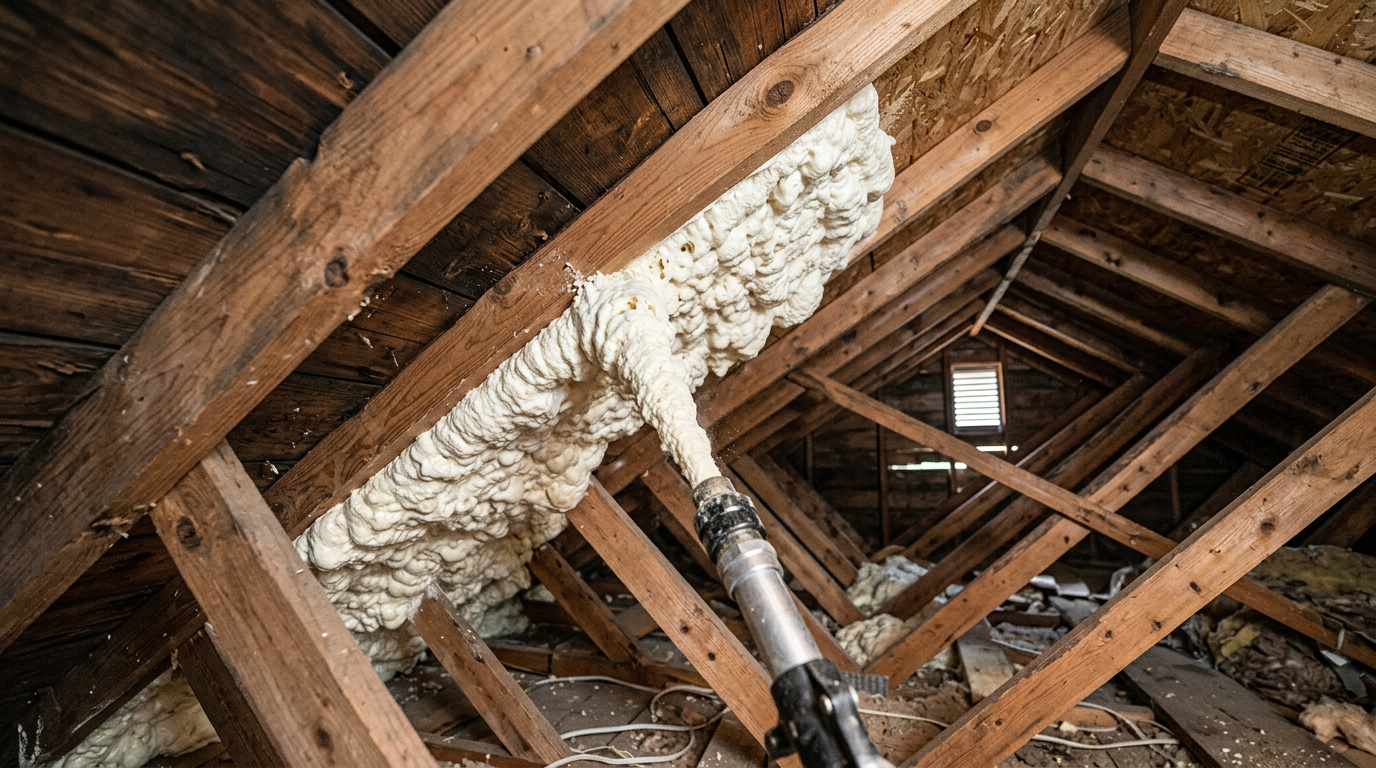
Spray Foam R-Value Explained: Per Inch, Per Product, and Why the Number Alone Misleads
The r-value of spray foam is one of the most cited numbers in insulation conversations, but it tells only part of the story. Understanding what that number actually measures - and what it leaves out - helps Missouri homeowners and builders make smarter decisions about their insulation investment.
What R-Value Actually Measures
R-value is a laboratory measurement of a material's resistance to conductive heat flow. The test is run under controlled, static conditions with no air movement (ASTM C518). That last detail matters more than most people realize: the test assumes a perfectly still environment, which is nothing like the inside of a wall cavity or attic on a windy Missouri winter day.
The number tells you how well a material slows heat moving through it by conduction alone. It says nothing about air leakage, moisture, or thermal bridging - three factors that can dramatically reduce how well any insulation actually performs in a real building.
R-Value Per Inch: Open-Cell vs. Closed-Cell
Spray foam comes in two main types, and their per-inch R-values are meaningfully different.
Open-Cell Spray Foam
Open-cell foam has an R-value of approximately R-3.6 to R-3.8 per inch, according to industry testing data. It is a low-density, flexible material - roughly 0.5 lb per cubic foot - with an interconnected cell structure that allows moisture vapor to pass through. Because it is vapor-permeable, it is not a vapor retarder on its own.
Open-cell foam is often applied in thicker passes. A standard 2x6 wall cavity filled with open-cell foam yields roughly R-20 for the cavity portion. It also provides excellent sound dampening, which makes it a popular choice for interior walls and floor assemblies.
Closed-Cell Spray Foam
Closed-cell foam delivers R-6.0 to R-7.0 per inch for standard medium-density (2 lb/ft³) formulations, with some high-density products reaching R-8.0 per inch, per product testing data. The higher R-value comes from the blowing agents trapped inside the rigid, sealed cells.
Closed-cell foam is also a Class II vapor retarder when applied at sufficient thickness - a fact that matters in Missouri's mixed-humid climate where moisture management is critical. It adds structural rigidity to wall and roof assemblies, and it resists liquid water intrusion in ways open-cell foam cannot.
Why the Number Alone Misleads
Here is where the conversation gets more nuanced. Two insulation products can have identical R-values and perform very differently in a real building. The r-value of spray foam is only one piece of the performance picture.
Air Leakage Is Not Captured by R-Value
Standard R-value testing assumes no air movement. In practice, air leakage accounts for a significant portion of a home's energy loss. Traditional insulation materials like fiberglass batts are air-permeable - heat bypasses them entirely through gaps, cracks, and penetrations. Spray foam expands to fill those voids, creating a monolithic air barrier that fiberglass cannot replicate.
A building insulated with spray foam can outperform one with traditional insulation by more than the difference in R-value alone would predict, because the air-sealing benefit is not reflected in the R-value number at all. This is why we often see homeowners report energy savings of up to 40% after switching to spray foam - the air sealing is doing significant work that the R-value label never shows.
Thermal Bridging Reduces Whole-Wall Performance
R-value is measured for the insulation material itself, not for the entire wall assembly. Structural framing - studs, plates, headers - conducts heat much faster than insulation. In a typical framed wall, thermal bridging can reduce the effective whole-wall R-value by 20% to 40% compared to the nominal cavity R-value, according to building science research.
Spray foam applied to the full roof deck or wall substrate can cover framing members and reduce this bridging effect. Fiberglass batts installed between studs leave every stud exposed as a thermal bridge.
Moisture Degrades Other Insulation Types
Moisture intrusion can reduce the effective R-value of cellulose insulation by as much as 30%. Spray foam - particularly closed-cell - resists moisture absorption and maintains its thermal performance over time. Open-cell foam can absorb liquid water if exposed to a leak, which is a design consideration for crawl spaces and below-grade applications.
"Effective R-Value" Claims Require Scrutiny
Some spray foam marketing uses the phrase "effective R-value" or "equivalent R-value" to suggest that air-sealing performance allows for lower insulation levels than code requires. Building science experts caution against this framing. Air sealing and insulation serve distinct physical functions, and energy codes treat them as separate requirements. A building inspector enforces the prescriptive R-value on the permit, not a manufacturer's marketing claim about equivalent performance.
The honest answer: spray foam performs better than its R-value label suggests, but the R-value still matters and still needs to meet code.
How We Apply This in Missouri
We install both open-cell and closed-cell spray foam across Greene, Christian, and Webster counties. The right choice depends on the application:
Attic Roof Deck (Unvented Assembly) Closed-cell foam applied directly to the underside of the roof deck creates a conditioned attic space. This approach eliminates the vented attic entirely, keeps HVAC equipment in conditioned space, and prevents ice dams. The higher per-inch R-value of closed-cell foam means we can meet code requirements in a thinner profile - important when roof deck clearance is limited.
Crawl Space Walls and Floor Closed-cell foam on crawl space walls and rim joists provides both thermal resistance and moisture control. This is the application where its vapor-retarding properties matter most. Crawl space encapsulation with spray foam typically runs $2,500 to $8,000 depending on size and access conditions.
Pole Barns and Metal Buildings Open-cell foam applied to the interior of metal building walls and roof panels addresses condensation - a major problem in uninsulated metal structures. The foam eliminates the dew point problem by keeping the metal surface above the condensation threshold. See our attic spray foam insulation page for more on how we approach roof assemblies.
Wall Cavities in New Construction Either product works in wall cavities. Open-cell fills the full cavity depth easily and costs less per square foot. Closed-cell provides a higher R-value in the same cavity depth and adds vapor control, which matters in certain wall assemblies facing Missouri's humid summers.
Comparing the Two Products
Open-Cell Spray Foam R-value per inch: R-3.6 to R-3.8 Density: approximately 0.5 lb/ft³ Vapor permeability: vapor-open (not a vapor retarder) Best uses: interior walls, sound control, full-cavity fill in new construction, attic roof deck in warm climates Cost: lower per square foot than closed-cell
Closed-Cell Spray Foam R-value per inch: R-6.0 to R-7.0 (standard); up to R-8.0 (high-density) Density: approximately 2.0 lb/ft³ Vapor permeability: Class II vapor retarder at sufficient thickness Best uses: crawl spaces, rim joists, metal buildings, unvented roof assemblies, tight spaces requiring high R-value in thin profile Cost: higher per square foot, but less material needed to reach the same total R-value
Frequently Asked Questions
Does spray foam R-value decrease over time?
Closed-cell foam can experience a modest reduction in R-value as the blowing agent gases slowly diffuse from the cells over the first few years - a process called thermal drift. Manufacturers provide long-term stabilized R-value figures that account for this. Open-cell foam maintains a stable R-value throughout its lifespan because its cells are open and not relying on trapped gases for thermal performance.
How thick does spray foam need to be to meet Missouri building code?
Required thickness depends on the climate zone and the application. Missouri falls primarily in Climate Zone 4, with some areas in Zone 5. Required attic R-values are typically R-38 to R-49 for new construction. At R-6.5 per inch for closed-cell foam, reaching R-38 requires roughly 6 inches. At R-3.7 per inch for open-cell, reaching R-38 requires roughly 10 inches. We calculate the required thickness for each project based on the specific code path and application.
Is a higher R-value always better?
Not necessarily. The right R-value is the one that meets code for your climate zone and application, installed in a way that also addresses air sealing and moisture management. Chasing a higher R-value while ignoring air leakage paths can leave significant energy performance on the table. We evaluate the whole assembly - not just the insulation layer - when we design a scope of work.
Bottom line:
The r-value of spray foam is a useful starting point, but the real performance advantage comes from the combination of thermal resistance, air sealing, and moisture control working together. If you want to understand what your specific project needs - and which product makes sense for your budget and application - we are happy to walk through it with you.
For more on how open-cell and closed-cell products compare in Missouri conditions, see our post on open-cell vs. closed-cell spray foam for Missouri homes.
Foam Fortress serves Springfield, Nixa, Ozark, Republic, Battlefield, Rogersville, Willard, and Marshfield. Call us at 417-224-8734 or visit us at 140 York Dr, Marshfield MO 65706.