
Is Spray Foam Insulation Safe? Curing, Off-Gassing, and When You Can Move Back In
Spray foam insulation is safe once fully cured. Learn about off-gassing, curing times, and when you can safely move back in after installation.
Is Spray Foam Insulation Safe? Curing, Off-Gassing, and When You Can Move Back In
Spray foam insulation is it safe — and the honest answer is yes, once it has fully cured and your home has been properly ventilated. The key is understanding what happens during and immediately after installation so you know exactly what to expect and when it is safe to return.
What Happens During Spray Foam Installation
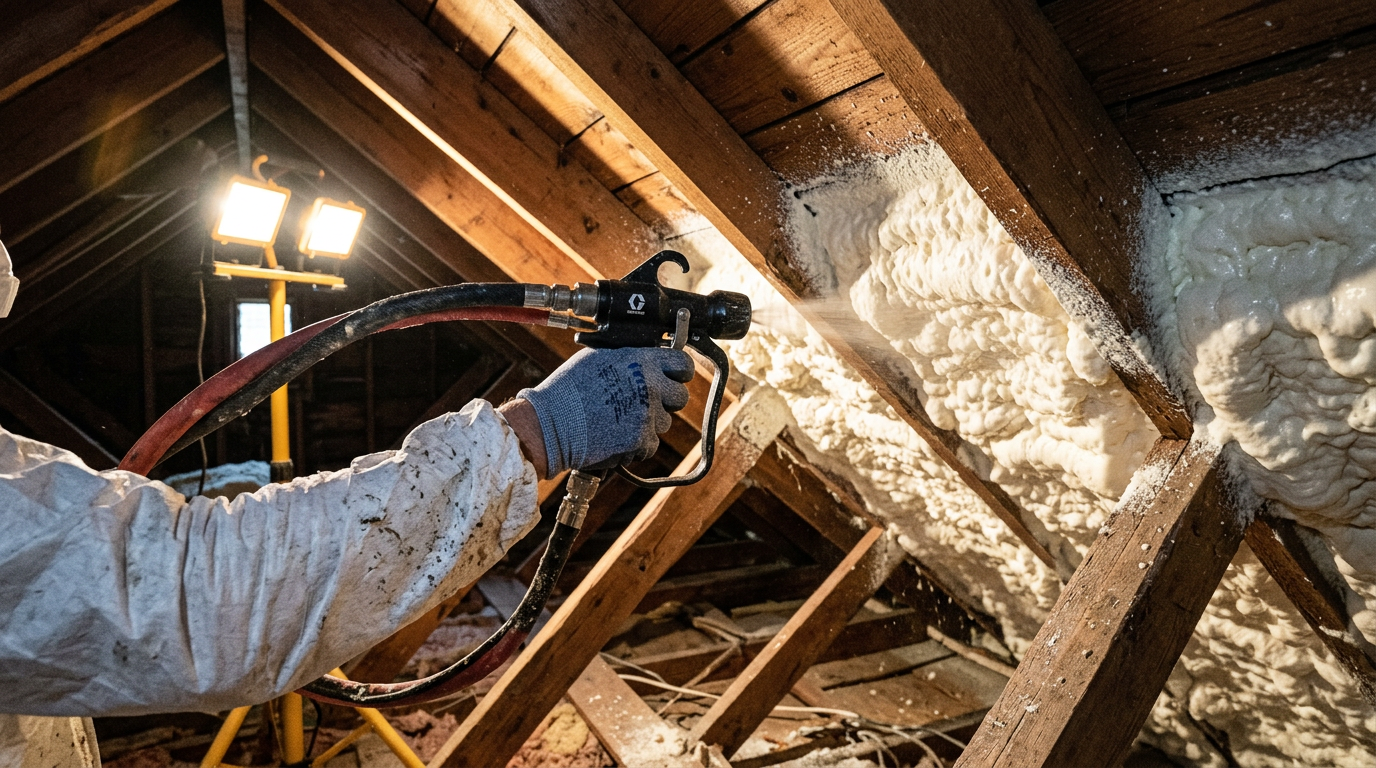
When we install spray foam, two liquid components — an A-side (isocyanates) and a B-side (polyols, catalysts, and blowing agents) — are mixed at the spray gun tip. They react almost instantly, expanding and hardening into the foam you see in your walls, attic, or crawl space. That chemical reaction is exothermic, meaning it generates heat, and it releases vapors and aerosols in the process.
This is why everyone — homeowners, pets, and any other trade workers — must leave the building before we start spraying. The fumes during active application are not something you want to breathe. Our installers wear full respirators and protective gear for exactly this reason.
What Is Off-Gassing and How Long Does It Last
Off-gassing is the release of residual volatile organic compounds (VOCs) and trace chemical byproducts as the foam finishes curing. It is most intense in the first few hours after application and tapers off as the foam hardens into a stable, inert plastic.
The duration depends on the type of foam and site conditions:
Open-Cell Foam Open-cell foam has a porous structure that allows gases to escape more quickly. Most open-cell installations reach safe VOC levels within 24 to 48 hours, assuming adequate ventilation.
Closed-Cell Foam Closed-cell foam is denser and less permeable. Gas diffusion takes longer, and most manufacturers and industry guidelines recommend waiting 48 to 72 hours before re-occupancy for closed-cell applications. Closed-cell foam is also a Class II vapor retarder, which is part of why it performs so well in Missouri's humid summers — but that same density means the curing window is longer.
What Affects the Timeline Several factors influence how quickly off-gassing clears:
Temperature: Warmer conditions accelerate the curing reaction. A job done in July in a Missouri attic cures faster than one done in a cold January crawl space.
Humidity: High humidity can slow the curing process and extend the off-gassing window.
Ventilation: This is the biggest variable. A house with open windows and fans running clears vapors far faster than a sealed, unventilated space.
Application thickness: Thicker applications take longer to fully cure throughout.
What the EPA Says
The U.S. Environmental Protection Agency has published guidance on spray polyurethane foam safety. Their recommendations are straightforward: occupants must vacate during installation, the building must be thoroughly ventilated after the curing period, and re-entry should only happen after the manufacturer's specified time has passed. You can read their guidance at EPA Spray Polyurethane Foam Safety.
The EPA also notes that improper installation — wrong mixing ratios, foam applied too thick in a single pass, or inadequate ventilation — can lead to incomplete curing and persistent off-gassing. This is one of the strongest arguments for hiring a trained, experienced installer rather than attempting a DIY spray foam job.
When Can You Move Back In
For the jobs we do at Foam Fortress, we give every homeowner a specific re-entry window before we start. Here is the general framework:
Re-entry minimum: 24 hours after the last spray pass, with active ventilation running.
Standard recommendation: 24 to 48 hours for open-cell applications; 48 to 72 hours for closed-cell applications.
Sensitive occupants: If anyone in your household has asthma, chemical sensitivities, or respiratory conditions — or if you have infants, young children, or pregnant family members — we recommend erring toward the longer end of the window. The same applies to pets.
We do not rush this. If you call us and ask whether it is safe to go back in early, we will tell you to wait. The foam is not going anywhere, and neither is your family's health.
Is Fully Cured Spray Foam Safe Long-Term
Yes. Once spray foam has fully cured, it becomes a chemically stable, inert material. It does not continue to off-gas, it does not degrade under normal conditions, and it does not release harmful compounds into your living space. The foam you see in a wall cavity that was installed ten years ago is the same chemically inert material it was the day it finished curing.
The concern is always with the curing window — not with the finished product.
What Proper Installation Looks Like
The safety of spray foam is directly tied to the quality of the installation. Here is what we do on every job to make sure the curing process goes correctly:
We calibrate our equipment before every job to ensure the A-side and B-side components are mixing at the correct ratio. An off-ratio mix is the most common cause of incomplete curing and persistent odors.
We apply foam in passes of appropriate thickness rather than trying to build up the full depth in a single thick layer. Thick single-pass applications trap heat and can cure unevenly.
We confirm ventilation is in place before we leave the job site.
We provide written re-entry instructions to every homeowner.
FAQ
Does spray foam smell after it cures?
A faint chemical odor is normal for the first day or two after installation. Once the foam is fully cured and the space has been ventilated, the smell should be gone. If you notice a persistent chemical odor after the recommended re-entry window, contact your installer — it may indicate incomplete curing that needs to be addressed.
Can I stay in part of the house while spray foam is being installed in another area?
No. During active spraying, the entire building should be vacated. Vapors and aerosols can travel through HVAC systems, gaps in walls, and open doorways. We ask all occupants — including pets — to leave before we begin and to stay out until the re-entry window has passed.
Is spray foam safe for people with allergies or asthma?
Once fully cured, spray foam is generally considered safe for people with allergies and asthma. In fact, because spray foam seals air leaks, it often reduces the infiltration of outdoor allergens, dust, and humidity that trigger symptoms. The concern is during the curing window — anyone with respiratory sensitivities should wait the full recommended time before re-entering.
Bottom line: Spray foam insulation is safe when installed correctly by trained professionals and when the proper re-entry window is observed. The curing phase is temporary; the performance benefits last for the life of the building.
We install spray foam across Springfield, Nixa, Ozark, Republic, Battlefield, Rogersville, Willard, and Marshfield. If you have questions about what to expect during and after installation, we are happy to walk you through the process before we ever start a job.
For more on how spray foam affects the air inside your home, read our post on how spray foam insulation improves indoor air quality for Missouri families. If you want to know exactly what happens on installation day, we cover it step by step in what happens during professional spray foam installation.