
Commercial Spray Foam in Springfield: Warehouses, Churches, and Retail Buildouts
Spray foam insulation commercial projects in Springfield, MO demand more than residential installs. Here's how we approach warehouses, churches, and retail buildouts.
Commercial Spray Foam in Springfield: Warehouses, Churches, and Retail Buildouts
Spray foam insulation commercial projects in Springfield, Missouri look very different from a residential attic job — the buildings are bigger, the stakes are higher, and the insulation has to perform across thousands of square feet of roof deck, wall cavity, and exposed metal framing. We install commercial spray foam across Greene, Christian, and Webster counties, and the questions we hear most often from building owners and contractors are the same: what does it actually do for a commercial building, how does it compare to other options, and what should I expect from the process?
Why Commercial Buildings Lose So Much Energy
A warehouse, church, or retail shell is essentially a giant thermal sieve. Metal roofs conduct heat directly. Exposed steel framing creates thermal bridges that bypass whatever insulation is between the studs. Large open volumes mean any air leak gets amplified — a small gap in a 40,000-square-foot warehouse moves a lot more air than the same gap in a 2,000-square-foot house.
According to the U.S. Department of Energy, warehouses and distribution centers alone make up 15.5% of total U.S. commercial floor area, and space heating and cooling account for nearly 29% of commercial site energy use. The building envelope — roof, walls, and floor — is the single most important factor in reducing that load.
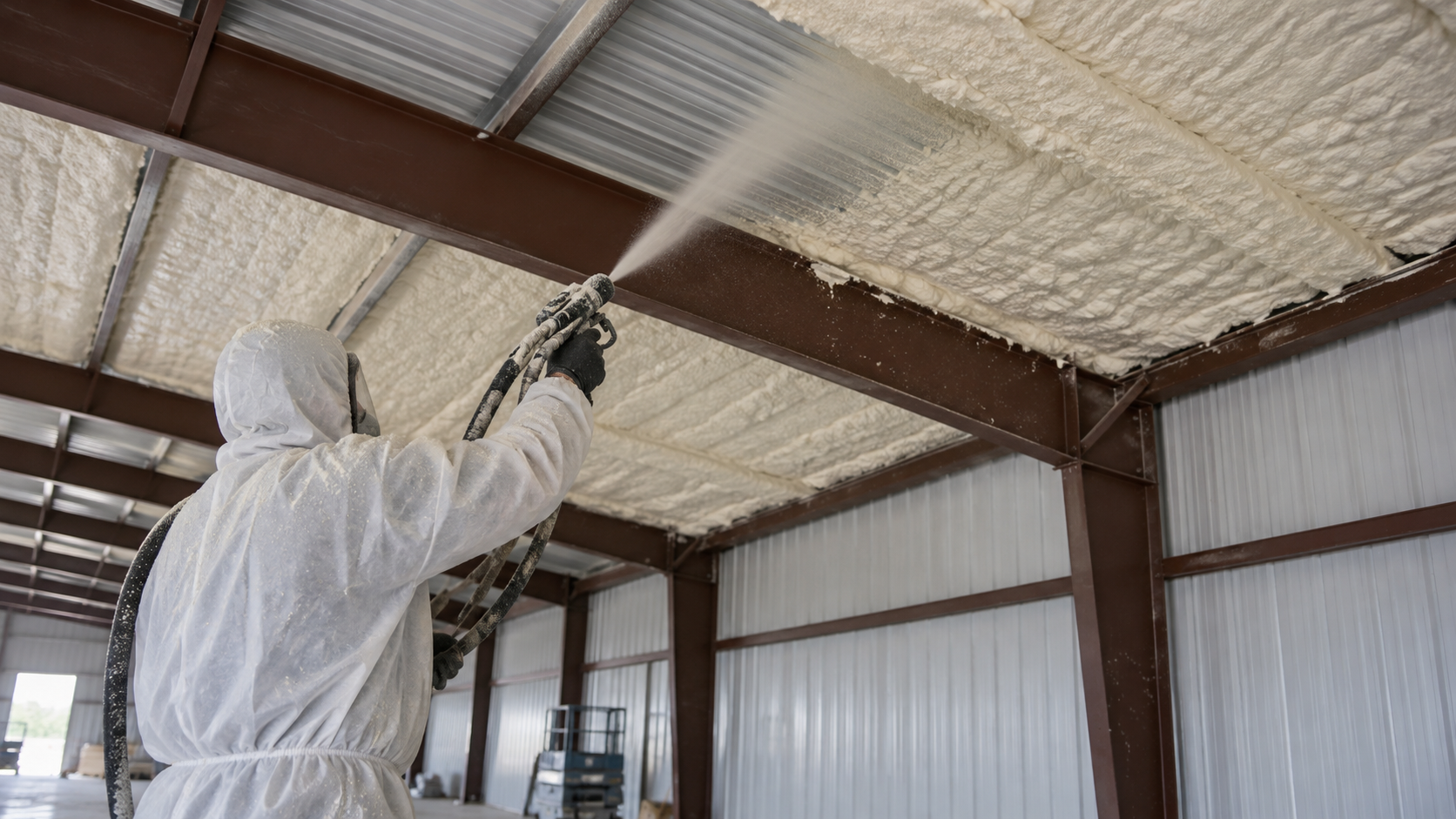
Spray foam addresses the problem at the source. Closed-cell foam applied directly to the underside of a metal roof deck or to the interior face of metal walls creates a continuous, seamless layer that acts as insulation, air barrier, and vapor retarder all at once. There are no seams for air to sneak through, no gaps around fasteners, and no compressed fiberglass losing half its rated R-value because it's touching a steel purlin.
What We Install in Commercial Buildings Around Springfield
We work on a range of commercial building types across the Springfield metro area. Each one has its own set of challenges.
Warehouses and Distribution Buildings
Metal-framed warehouses are one of the most common commercial jobs we take on. The roof deck is usually exposed steel, and the walls are metal panels over steel framing. Traditional fiberglass blanket insulation — the kind that comes in rolls and gets draped between purlins — compresses against the metal and loses a significant portion of its rated R-value at every framing member. DOE-backed field studies on metal buildings have found that targeted spray insulation retrofits can yield up to 30% savings on heating energy alone.
We spray closed-cell foam directly to the underside of the roof deck and to the interior face of the wall panels. The foam bonds to the metal, fills every gap around fasteners and penetrations, and creates a rigid, continuous thermal layer. The result is a building that holds temperature, reduces HVAC runtime, and stops the condensation problems that plague uninsulated metal buildings in Missouri's humid summers.
Churches and Assembly Buildings
Churches present a different set of challenges. The buildings are often older, with cathedral ceilings, large open volumes, and HVAC systems that were sized for a poorly insulated envelope. We've worked on churches in Springfield and the surrounding area where the heating bill was running well above what it should be for the square footage.
In these buildings, we typically spray open-cell foam in the roof cavity — it fills the irregular framing, conforms to curved or vaulted surfaces, and provides excellent sound attenuation as a side benefit. For exterior walls with existing framing, we can inject foam into closed cavities or spray open-wall sections during a renovation. The goal is to bring the building envelope up to a level where the existing HVAC can actually keep up without running constantly.
Retail Buildouts and Tenant Improvements
Retail shells and tenant improvement projects are time-sensitive. A contractor building out a new restaurant, gym, or retail space needs the insulation done on a schedule that doesn't hold up the rest of the trades. We work directly with general contractors on these projects and can typically complete a commercial spray foam scope in one to two days for most retail-scale buildouts.
For retail, the most common application is the roof deck and any exterior walls that aren't already insulated. We also get called in to address specific problem areas — a walk-in cooler that's sweating, a back-of-house area that's always cold in winter, or a loading dock wall that's never been properly sealed.
How Spray Foam Compares to Other Commercial Insulation Options
Spray Foam (Closed-Cell) R-value per inch: approximately R-6 to R-7. Acts as air barrier, vapor retarder, and insulation in one application. Bonds directly to metal, concrete, and wood. No separate vapor barrier required. Higher upfront cost, lower long-term energy cost.
Fiberglass Batt or Blanket R-value per inch: approximately R-3 to R-4. Requires separate air barrier and vapor barrier. Loses effective R-value at framing members due to thermal bridging. Lower upfront cost, higher long-term energy cost in metal buildings.
Rigid Board Insulation R-value per inch: approximately R-4 to R-6.5 depending on type. Good continuous insulation option for above-deck applications. Requires careful detailing at seams and penetrations to maintain air barrier continuity. Often used in combination with spray foam at transitions.
Spray Foam (Open-Cell) R-value per inch: approximately R-3.5 to R-4. Excellent for filling irregular cavities and sound attenuation. Not a vapor retarder — requires separate vapor control in some applications. Lower cost than closed-cell, good for interior roof cavities in conditioned spaces.
Missouri Code Considerations for Commercial Projects
Missouri does not have a mandatory statewide commercial energy code, which means requirements are set at the local level. Most jurisdictions in the Springfield area fall within Climate Zone 4A, and local building departments typically reference the International Energy Conservation Code (IECC) or ASHRAE 90.1 for commercial projects.
When jurisdictions adopt modern IECC standards for Climate Zone 4, prescriptive targets for commercial roofs often require continuous insulation values around R-30. Closed-cell spray foam at 4 to 5 inches meets or exceeds that target in a single pass, without the need for separate continuous insulation layers above the deck.
We work with your general contractor and building department to confirm what's required for your specific project and jurisdiction. We don't guess at code requirements — we verify them before we quote.
What the Installation Process Looks Like
Most commercial spray foam jobs follow a similar sequence. We start with a site walk to assess the substrate, identify any moisture issues, and confirm the scope. Metal surfaces need to be clean and dry before foam is applied — we check for condensation, rust, and any existing coatings that might affect adhesion.
On installation day, we set up containment to protect finished areas and equipment. Spray foam generates heat and off-gasses during the cure period, so the building needs to be ventilated and unoccupied during application and for a period afterward. We coordinate the schedule with your GC to minimize impact on other trades.
Most residential jobs take one to two days. Commercial projects vary by square footage and complexity — a 10,000-square-foot warehouse roof might be a one-day job; a full building envelope on a larger structure could take two to three days. We give you a realistic timeline before we start, not an optimistic one.
FAQ
Does spray foam meet commercial fire code requirements?
Yes, with the right installation approach. Foam plastic insulation in commercial buildings must comply with the International Building Code Chapter 26, which requires a thermal barrier — typically 1/2-inch gypsum wallboard — between the foam and the occupied interior, unless a specific exception applies. We install foam in compliance with local code requirements and can coordinate with your building department on any project-specific questions.
Can spray foam be added to an existing commercial building?
Absolutely. Retrofit applications are common, especially in older metal buildings that were built with minimal insulation. We can spray directly over existing substrates in most cases. If there's existing insulation that's damaged or moisture-compromised, we'll identify that during the site walk and discuss options before we quote.
How does spray foam affect a commercial building's HVAC sizing?
A properly insulated building envelope reduces the heating and cooling load, which means your existing HVAC system runs less often and lasts longer. If you're planning a new buildout, a well-insulated envelope can allow you to right-size the HVAC system rather than oversizing it to compensate for a leaky building. We can provide documentation of the insulation scope for your mechanical engineer if needed.
Bottom line:
Commercial spray foam insulation in Springfield is one of the highest-return investments a building owner or developer can make — it reduces energy costs, eliminates condensation problems, and creates a building envelope that performs for decades without maintenance.
If you're planning a warehouse, church renovation, or retail buildout in the Springfield area, we'd be glad to walk the building with you and put together a scope. Learn more about our commercial spray foam services or see how spray foam compares on a long-term cost basis in our post on spray foam vs. fiberglass over 20 years.