
Can You Spray Foam Existing Walls? Injection Foam vs Open-Wall Retrofit
Learn how spray foam insulation in existing walls works — injection foam vs open-wall retrofit — and which method is right for your Missouri home.
Can You Spray Foam Existing Walls? Injection Foam vs Open-Wall Retrofit
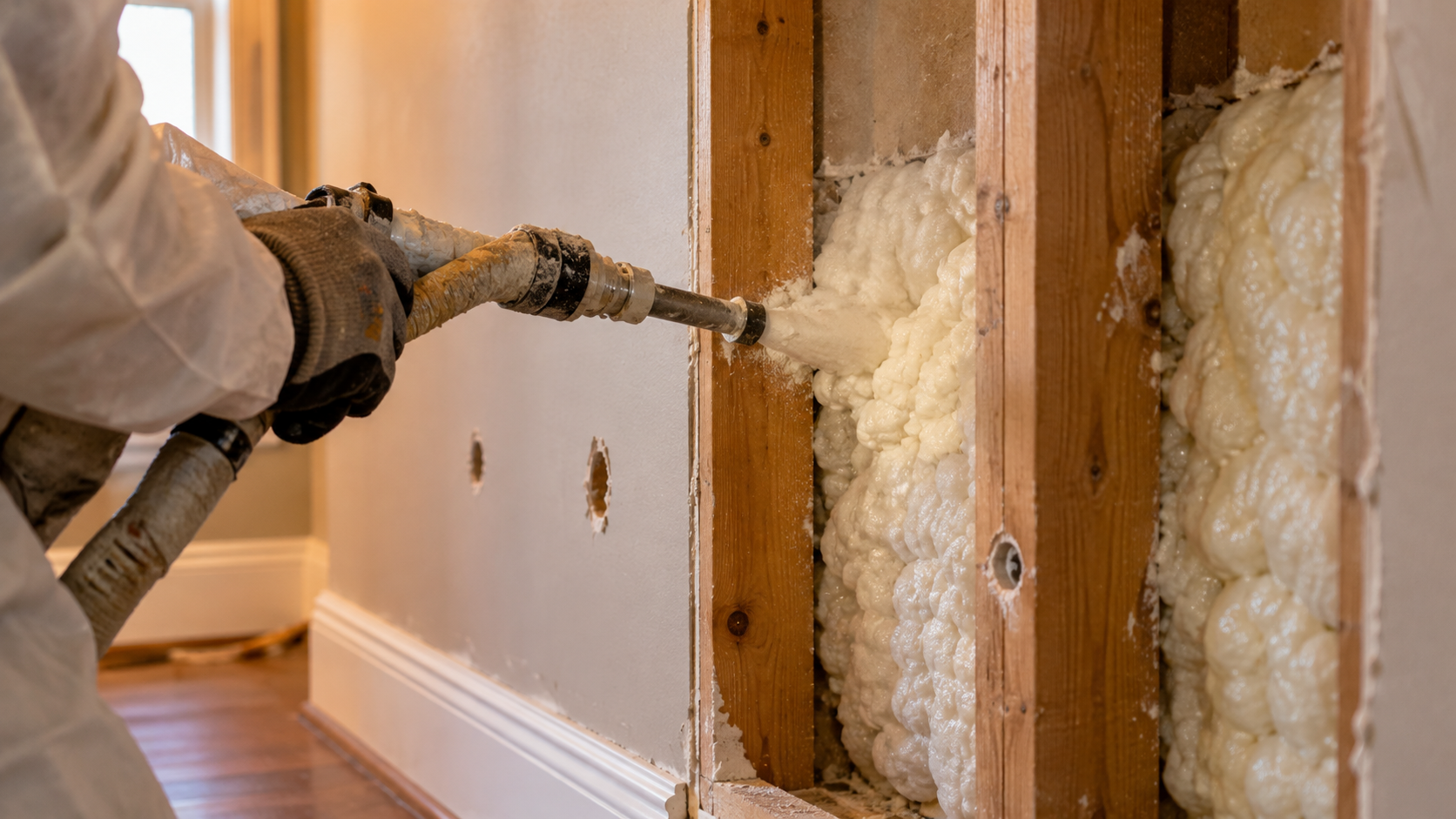
Spray foam insulation in existing walls is possible, but the method depends entirely on whether your walls are open or closed. We install both open-wall spray foam during renovations and injection foam for finished walls — and knowing the difference saves you time, money, and a lot of drywall.
Why Wall Insulation Matters in Missouri Homes
Missouri sits in a mixed-humid climate zone where summer heat and winter cold both push through under-insulated walls. Older homes in Springfield, Marshfield, Nixa, and surrounding areas were often built with minimal wall insulation — sometimes just a thin layer of fiberglass batt that has settled or shifted over decades. That gap between your drywall and your siding is where conditioned air escapes and outdoor air sneaks in.
Improving wall insulation is one of the highest-impact upgrades a homeowner can make. Up to 40% energy savings are possible when air sealing and insulation are addressed together. The question is how to get there without tearing your house apart.
Two Paths: Open-Wall vs Closed-Wall Retrofit
The approach we take depends on whether your walls are currently open or finished.
Open-Wall Retrofit
An open-wall retrofit happens when the wall cavity is exposed — during a gut renovation, an addition, or when siding is being replaced. In this case, we spray foam directly onto the studs before drywall goes up. This is the most thorough option because we can see every stud bay, every rim joist, and every penetration.
For exterior walls in Missouri's climate, we typically recommend closed-cell spray foam in open-wall applications. Closed-cell foam is a Class II vapor retarder, which means it controls moisture movement through the wall assembly — critical in a climate that swings from humid summers to cold winters.
Closed-Wall Retrofit (Injection Foam)
If your walls are already finished and you do not want to remove drywall, injection foam is the answer. Injection foam is a different product from standard spray foam — it is formulated to flow through small drilled holes and fill the cavity without the high expansion pressure that would crack your drywall.
The process works like this: we drill small holes through the exterior siding or interior drywall (depending on your preference), inject the foam until the cavity is full, then patch and paint the holes. Most homeowners cannot tell the work was done once it is finished.
Injection foam typically delivers an R-value of approximately R-4.5 to R-5.0 per inch, which fills a standard 2x4 wall cavity to roughly R-13 to R-15. That is a meaningful improvement over an empty or poorly filled cavity.
Spray Foam Insulation in Existing Walls: What the Process Looks Like
When we do a closed-wall injection job, here is what to expect:
We start with a thermal scan or moisture check to confirm the wall cavities are dry and free of existing problems. Wet insulation or hidden moisture needs to be addressed before we seal anything in.
Next, we drill access holes — typically 1 to 2 inches in diameter — at intervals along each stud bay. The spacing depends on the wall height and any obstructions like blocking or fire stops inside the cavity.
We inject the foam from the bottom up, watching for fill indicators at each hole. The foam flows around wiring, pipes, and any existing insulation before curing in place.
Finally, we patch the holes with matching material and leave the wall ready for paint. Most residential wall injection jobs are completed in one day.
Comparing Your Options
Standard Spray Foam (Open Wall)
R-value per inch: R-3.5 to R-3.9 (open-cell) or R-5.6 to R-8.0 (closed-cell) Best for: New construction, gut renovations, open stud bays Vapor control: Closed-cell acts as a Class II vapor retarder Access required: Wall cavity must be open
Injection Foam (Closed Wall)
R-value per inch: R-4.5 to R-5.0 Best for: Finished walls, occupied homes, minimal disruption Vapor control: Varies by product — ask your installer Access required: Small drilled holes only, no drywall removal
Open-Cell Spray Foam (Interior Partitions)
R-value per inch: R-3.5 to R-3.9 Best for: Interior walls where sound control is the goal Vapor control: Permeable — not a vapor retarder Access required: Open wall cavity
When Injection Foam Is the Right Call
Injection foam makes the most sense when:
Your home is occupied and you cannot live through a full renovation. Injection work is low-disruption — we are in and out in a day with minimal mess.
You are replacing siding anyway. If the exterior is coming off, we can inject from the outside and patch the siding as part of the same project.
You have an older home with no wall insulation at all. Many homes built before the 1980s in Greene, Christian, and Webster counties were built with empty wall cavities. Injection foam turns those empty bays into a real thermal barrier.
You want to improve comfort without a major remodel. If certain rooms feel drafty or hard to heat and cool, targeted wall injection can solve the problem without touching the rest of the house.
When Open-Wall Spray Foam Is Worth the Extra Work
If you are already opening walls for another reason — a kitchen remodel, a bathroom gut, a room addition — that is the time to do spray foam right. Open-wall application lets us achieve higher R-values, address every penetration, and use closed-cell foam for full vapor control.
We also recommend open-wall spray foam for any exterior wall that has had moisture problems. If there is any history of water intrusion, we want to see inside the cavity before we seal it.
FAQ
Can injection foam be installed over existing fiberglass batts?
Yes, in most cases. Many injection foam products are designed to flow around and through existing insulation, improving the overall performance of the wall assembly. We assess each situation before recommending this approach, since heavily compressed or wet batts may need to be removed first.
How long does injection foam last in a wall?
Properly installed injection foam is a permanent solution. It does not settle, shift, or degrade the way fiberglass batts can over time. Once it cures in the cavity, it stays put.
Will injection foam damage my drywall or siding?
When installed correctly, no. The key is using a product formulated for closed-cavity injection — not standard spray foam, which expands too aggressively for a finished wall. We use products designed specifically for retrofit applications, and we drill holes sized to match the injection equipment so patching is clean and minimal.
Bottom line:
If your walls are open, spray foam is the clear choice for maximum performance. If your walls are finished, injection foam gives you a real upgrade without tearing anything apart — and we can handle both.
We serve homeowners across Springfield, Nixa, Ozark, Republic, Battlefield, Rogersville, Willard, and Marshfield. If you are not sure which approach fits your home, we are happy to walk through it with you.
Learn more about our residential spray foam services or read how we approach retrofitting spray foam in older Missouri homes.
What to Expect from Your Energy Bills After Wall Insulation
Wall insulation alone will not eliminate your heating and cooling costs, but it removes one of the biggest sources of heat loss in an older home. When combined with attic insulation and crawl space encapsulation, wall insulation is part of a whole-house approach that can reduce energy use significantly. We often see homeowners report noticeably more even temperatures room to room after a wall injection project — that draft that always bothered you in the corner bedroom tends to disappear.
Call us at 417-224-8734 to schedule a free estimate. We will assess your walls, check for moisture, and recommend the right approach for your home and budget.