
Air Barrier vs Insulation: Why Spray Foam Does Both and Fiberglass Does Neither Well
Comparing fiberglass insulation vs spray foam? Spray foam is the only material that acts as both a thermal barrier and a continuous air barrier in one step.
Air Barrier vs Insulation: Why Spray Foam Does Both and Fiberglass Does Neither Well
When Missouri homeowners compare fiberglass insulation vs spray foam, the conversation usually starts with R-value — but the real difference is air sealing. Spray foam is the only insulation material that functions as both a thermal barrier and a continuous air barrier in a single application, while fiberglass batts stop conductive heat transfer but allow air to move freely through and around them.
What an Air Barrier Actually Does
An air barrier is a material or system that resists the movement of air through the building envelope. Heat moves through a wall three ways: conduction (through solid material), convection (through moving air), and radiation. Fiberglass addresses conduction by trapping still air in its fibers. It does almost nothing about convection.
When wind pressure, stack effect, or HVAC pressure differences push air through gaps in your framing, that air carries heat with it — right past your fiberglass batts. Building scientists call this "convective bypass," and it is one of the primary reasons homes with code-minimum fiberglass insulation still feel drafty and run high utility bills.
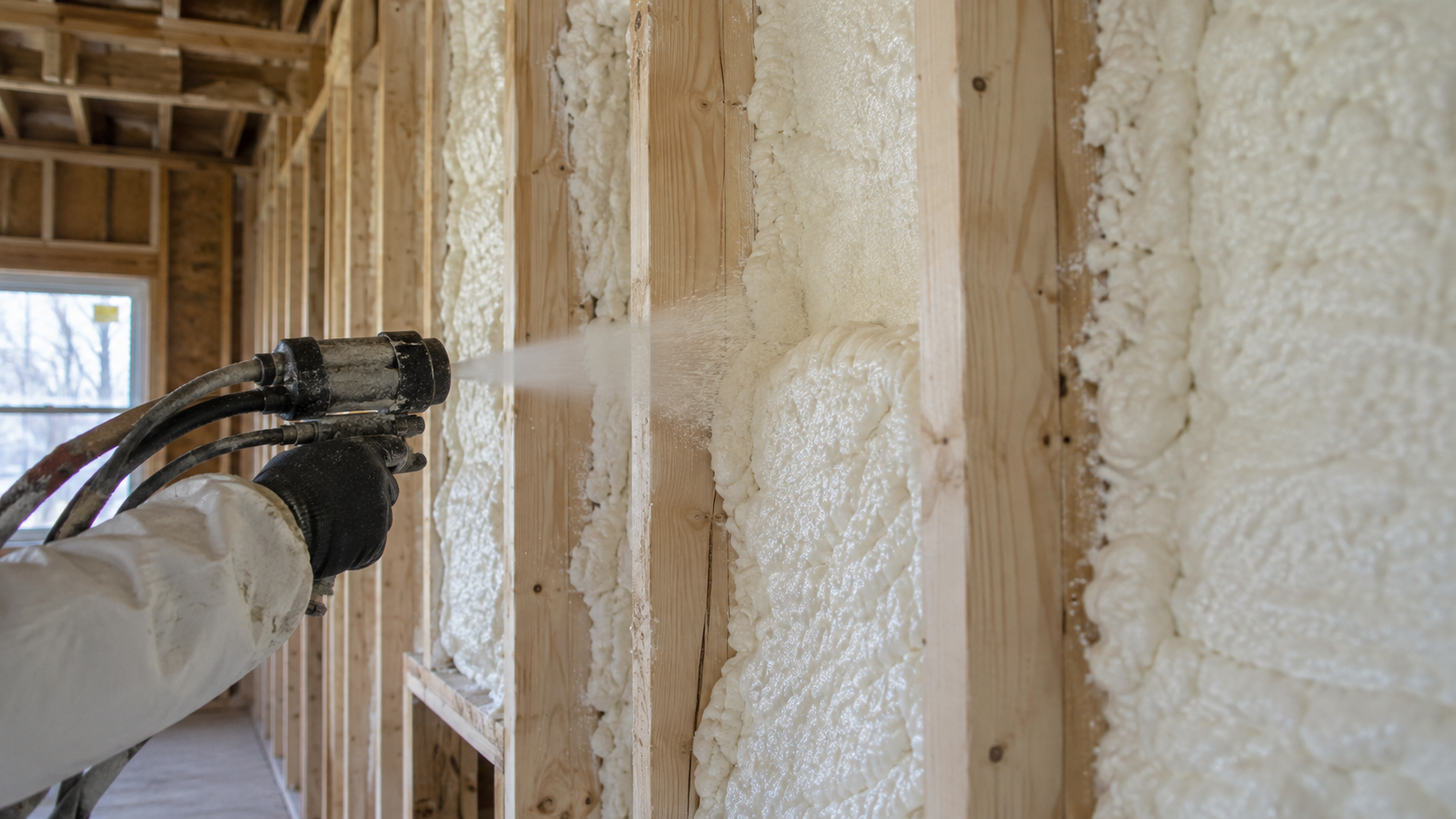
Spray foam expands to fill every gap, crack, and penetration. Once cured, it creates a monolithic seal that stops air movement at the source. You get thermal resistance and air control from one material, installed in one step.
Why Fiberglass Falls Short as an Air Barrier
Fiberglass is an excellent thermal insulator when installed perfectly in a perfectly sealed cavity. The problem is that neither condition is easy to achieve in real construction.
The installation gap problem
Fiberglass batts must be cut and fitted around wiring, plumbing, blocking, and irregular framing. Any gap — even a small one — creates a path for air. Studies from the Building Science Corporation have shown that even small air gaps in a fiberglass assembly can reduce its effective thermal performance by 30 to 50 percent.
The compression problem
Fiberglass loses R-value when compressed. A 3.5-inch R-13 batt stuffed into a 2x4 cavity with wiring running through it is no longer performing at R-13. The actual installed performance is lower, and there is no easy way to verify it after drywall goes up.
The settling problem
Over time, fiberglass in walls and attics can sag, shift, and settle — especially in high-humidity environments like Missouri summers. Once it settles, it leaves gaps at the top of cavities where warm air rises and escapes.
How Spray Foam Solves Both Problems at Once
We install spray foam as a liquid that expands 30 to 60 times its original volume and adheres directly to framing, sheathing, and concrete. It conforms to every surface it touches, including around wires, pipes, and irregular framing members.
Open-cell spray foam
Open-cell foam is softer and more flexible. It provides excellent air sealing and sound dampening. It is vapor-permeable, which makes it a good choice for interior walls and attic applications in climate zones where you want the assembly to dry to the interior.
R-value per inch: approximately R-3.5 to R-3.8, comparable to fiberglass on a per-inch basis — but with full air sealing included.
Closed-cell spray foam
Closed-cell foam is denser and rigid. It provides superior R-value per inch and is a Class II vapor retarder, which means it slows moisture movement through the assembly. It also adds structural rigidity to walls and roof decks.
R-value per inch: approximately R-6 to R-7, nearly double fiberglass per inch of thickness.
For Missouri homes — where summer humidity is high and winter temperatures can drop well below freezing — closed-cell foam in rim joists, crawl spaces, and exterior walls gives you the most complete protection.
The Energy Savings Difference
Air leakage accounts for a significant share of a home's heating and cooling load. The U.S. Department of Energy estimates that sealing air leaks and adding insulation can reduce heating and cooling costs by up to 15 percent on average, with well-sealed homes seeing reductions of up to 40 percent compared to leaky, under-insulated homes.
Fiberglass alone cannot capture those savings because it does not address air leakage. You would need to add a separate air barrier — house wrap, rigid foam board, or meticulous caulking and gasket work — to get comparable results. That adds labor, materials, and coordination. Spray foam delivers both in one step.
Where We See the Biggest Difference in Missouri Homes
Rim joists
The rim joist is the band of framing that sits on top of your foundation wall. It is one of the most common air leakage points in older Missouri homes. Fiberglass stuffed into rim joist bays does almost nothing — it is not sealed at the edges and air moves freely around it. We cut and cobble closed-cell foam into rim joists to create a complete air and thermal seal.
Crawl spaces
An open or poorly sealed crawl space is a direct path for cold, humid air to enter your living space. Fiberglass batts stapled between floor joists are a common approach, but they fall down over time and do not stop air movement. We encapsulate crawl spaces with closed-cell foam on the walls and a vapor barrier on the floor, turning the crawl space into a semi-conditioned space that stays dry and stable year-round.
Attics
In a vented attic, open-cell spray foam applied to the underside of the roof deck creates an unvented, conditioned attic. Your HVAC equipment and ductwork — if located in the attic — are now inside the thermal envelope, which dramatically reduces duct losses. Fiberglass on the attic floor does not accomplish this because it leaves the attic itself outside the envelope.
Pole barns and metal buildings
Metal buildings are notorious for condensation problems. When warm, humid interior air contacts cold metal panels, moisture condenses on the surface. Fiberglass batts do not stop this because they do not seal the air. Closed-cell spray foam applied directly to the metal panels stops condensation by keeping the panel surface above the dew point.
Frequently Asked Questions
Is spray foam worth the higher upfront cost compared to fiberglass?
For most Missouri homeowners, yes. The higher upfront cost of spray foam is offset by lower utility bills, reduced HVAC wear, and the elimination of a separate air-sealing step. Most residential spray foam jobs we complete pay back the cost difference within a few years through energy savings, and the foam lasts the life of the building without settling or sagging.
Can I add spray foam over existing fiberglass insulation?
In some cases, yes. We often spray closed-cell foam into rim joists and crawl space walls even when fiberglass is present elsewhere in the home. In attics, we can remove existing fiberglass and replace it with open-cell foam on the roof deck, or add spray foam to specific problem areas. The right approach depends on your existing assembly and goals — we assess each home before recommending a scope.
Does spray foam work in older Missouri homes with irregular framing?
Yes, and it actually performs better in older homes than fiberglass does. Older homes often have non-standard stud spacing, settled framing, and more penetrations for pipes and wires. Spray foam expands to fill all of those irregularities. Fiberglass batts cut for standard 16-inch spacing leave gaps in a 15.5-inch or 17-inch cavity.
Bottom line:
Fiberglass insulates. Spray foam insulates and air-seals. In Missouri's mixed-humid climate, you need both functions — and spray foam delivers them in one step.
If you are ready to stop paying for heat and cooling that escapes through your walls, attic, or crawl space, we can help. Learn more about our residential spray foam services or see how we compare in our full spray foam vs traditional insulation breakdown. Call us at 417-224-8734 or reach out online to schedule a free assessment for your home in Springfield, Nixa, Ozark, Republic, Battlefield, Rogersville, Willard, or Marshfield.