
What a Class II Vapor Retarder Means for Your Crawl Space, and Why We Use Closed-Cell
Closed cell spray foam vapor barrier qualifies as a Class II vapor retarder in crawl spaces, controlling moisture, air movement, and heat loss in Missouri.
What a Class II Vapor Retarder Means for Your Crawl Space, and Why We Use Closed-Cell
Closed cell spray foam vapor barrier performance is one of the most misunderstood topics in residential insulation — most homeowners hear "vapor barrier" and picture a sheet of plastic, not a foam product that does three jobs at once. When we install closed-cell spray foam in a crawl space, we are placing a material that simultaneously insulates, blocks air movement, and controls moisture vapor, all in a single application.
What "Class II Vapor Retarder" Actually Means
Building codes classify vapor retarders by how much water vapor they allow to pass through, measured in perms. The lower the perm rating, the less vapor gets through.
Class I Perm rating of 0.1 or less. Examples: polyethylene sheeting, glass, aluminum foil. Nearly impermeable.
Class II Perm rating between 0.1 and 1.0. This is where closed-cell spray foam lands when applied at sufficient thickness. It slows vapor significantly without being completely vapor-tight.
Class III Perm rating between 1.0 and 10.0. Examples: latex paint, house wrap. Allows more vapor movement.
Closed-cell spray foam is a Class II vapor retarder — a fact confirmed by building science research and manufacturer technical data.pdf). At 1.5 to 2 inches of thickness, most closed-cell products achieve a perm rating at or below 1.0, meeting the Class II threshold. As thickness increases, the perm rating drops further.
Why Crawl Spaces Need Vapor Control
Missouri sits in a climate zone where ground moisture is a year-round concern. The soil under your home holds moisture, and that moisture wants to move upward — through the ground, into the air space of your crawl space, and eventually into your floor system and living areas above.
Without a proper vapor control layer, you get:
- Wood rot in floor joists and subfloor sheathing - Mold growth on framing members - Elevated indoor humidity that makes your HVAC work harder - Musty odors that migrate into the living space - Pest activity, since insects and rodents are drawn to damp, dark spaces
The IRC Section R408 requires all exposed earth in a crawl space to be covered with a continuous Class I vapor retarder — typically 6-mil polyethylene sheeting at minimum. But code minimum and best practice are not the same thing.
How Closed-Cell Foam Outperforms Plastic Sheeting
A 6-mil poly sheet covers the ground. Closed-cell spray foam covers the ground, the stem walls, the rim joists, and every penetration — and it stays put.
Plastic sheeting Covers exposed earth only. Seams can separate. Tears during maintenance visits. Does not insulate. Does not stop air movement through the foundation walls.
Closed-cell spray foam Adheres permanently to concrete, block, and wood. Covers stem walls and rim joists in addition to the ground. Provides R-value (insulation) while controlling vapor. Acts as an air barrier, stopping the stack effect that pulls humid crawl space air into the living space above.
The stack effect is worth understanding. In winter, warm air rises through your home and exits at the top. That creates negative pressure at the bottom, which pulls outside air — and crawl space air — upward. If your crawl space air is humid and moldy, that air ends up in your living room. Closed-cell foam on the walls and rim joists breaks that pathway.
What We Install and How
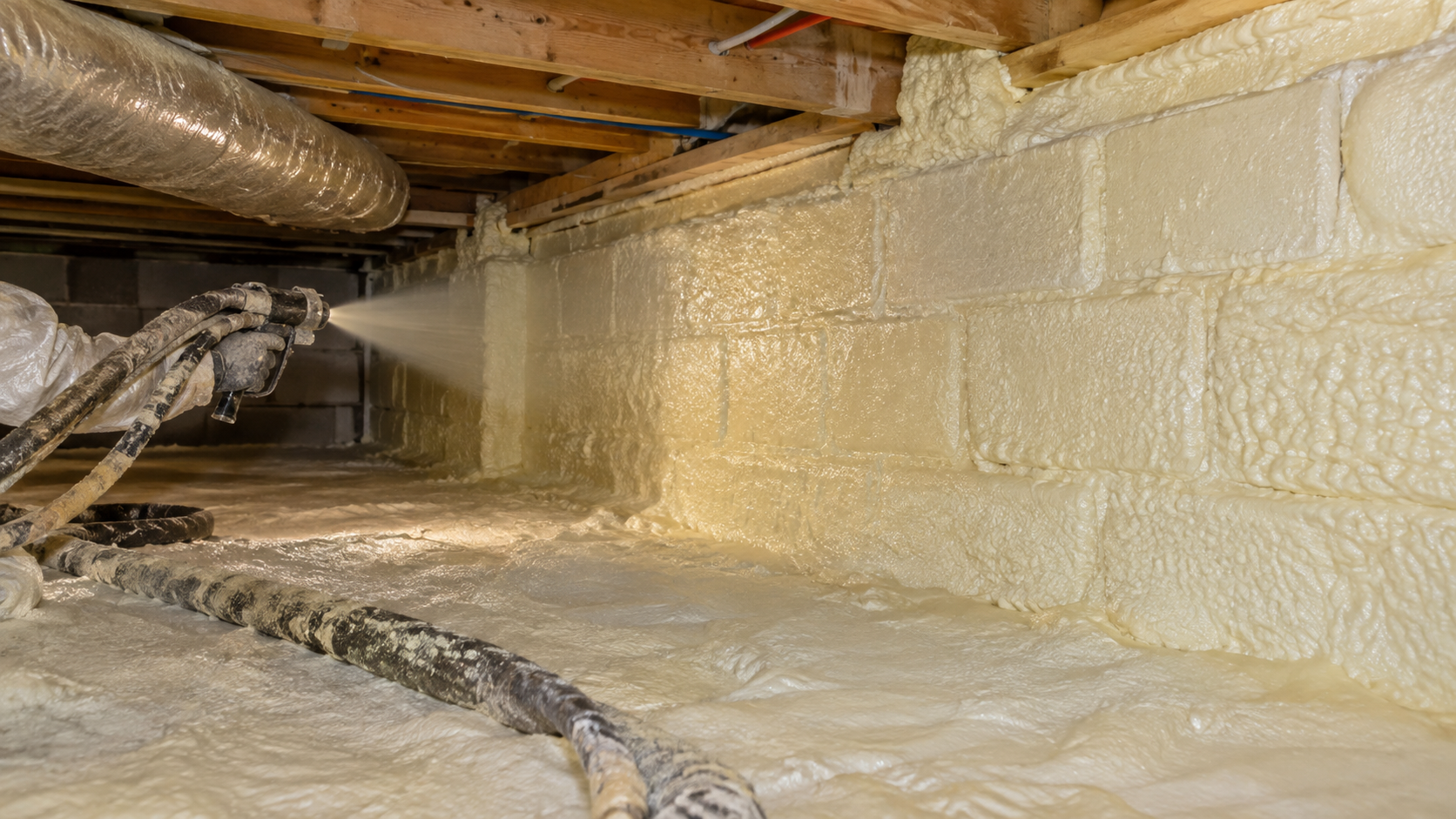
When we encapsulate a crawl space at Foam Fortress, we apply closed-cell spray foam to the interior of the foundation walls and across the rim joist area. This converts the crawl space from a vented, unconditioned space to a sealed, semi-conditioned space.
The process:
1. We inspect the crawl space for standing water, existing mold, or structural issues. Those get addressed before foam goes in. 2. We spray closed-cell foam on the stem walls from the sill plate down to the footing, typically 2 inches thick. 3. We spray the rim joist area — the band of framing that sits on top of the foundation wall — which is one of the biggest air and moisture entry points in any home. 4. Depending on the project, we may also apply foam to the ground or recommend a heavy-duty poly liner over the soil.
Most crawl space encapsulation jobs run 1 to 2 days. Total project cost typically falls in the $2,500 to $8,000 range depending on square footage, access conditions, and how much prep work the space needs.
The Moisture Science Behind the Decision
Here is why we choose closed-cell over open-cell for crawl spaces specifically.
Open-cell spray foam has a perm rating well above 1.0 — it is vapor-permeable. In a crawl space, that means ground moisture can still move through the foam and into the framing. Open-cell foam also absorbs liquid water if the crawl space floods or if condensation forms on the foam surface. That absorbed water can feed mold growth inside the foam itself.
Closed-cell foam does not absorb liquid water. Its rigid, closed-cell structure physically blocks water from entering the material. Combined with its Class II vapor retarder rating, it stops both liquid water intrusion and vapor diffusion.
For walls and attics, the choice between open-cell and closed-cell involves more trade-offs. For crawl spaces in Missouri's climate, closed-cell is the right call.
Energy Impact
Sealing and insulating a crawl space with closed-cell foam addresses one of the most overlooked sources of energy loss in a home. Heat moves through the floor system in winter. Humid air infiltrating through the crawl space forces your HVAC to work harder to maintain comfort. Homeowners who encapsulate their crawl spaces often see meaningful reductions in heating and cooling costs — up to 40% energy savings in some cases when combined with other air sealing work.
The floor above a properly encapsulated crawl space also feels warmer in winter. Cold floors are a comfort complaint we hear constantly from homeowners in older Missouri homes, and crawl space encapsulation is frequently the fix.
FAQ
Does closed-cell spray foam replace the need for a dehumidifier in a sealed crawl space?
Not always. When you seal a crawl space, you eliminate the ventilation that previously allowed some moisture to escape. In a sealed crawl space, the IRC recommends either conditioned air supply, mechanical exhaust, or a dehumidifier sized for the space. We assess each crawl space individually and let you know what moisture management the space needs after encapsulation.
How thick does the closed-cell foam need to be to qualify as a Class II vapor retarder?
Most closed-cell products reach Class II performance at 1.5 to 2 inches of thickness. The exact threshold depends on the specific product's technical data sheet. We verify the manufacturer specs for every product we use and apply at the thickness needed to meet or exceed the Class II rating.
Will spray foam in my crawl space affect my home's resale value?
A properly encapsulated crawl space is a selling point, not a liability. Home inspectors flag damp, moldy crawl spaces as significant defects. A sealed, foam-encapsulated crawl space with no moisture issues is something buyers and their inspectors notice positively. We can provide documentation of the work performed for your records.
Bottom line:
Closed-cell spray foam is a Class II vapor retarder that insulates, air-seals, and controls moisture in a single application — making it the most effective crawl space solution for Missouri homes where ground moisture and seasonal humidity are constant concerns.
If your crawl space has moisture issues, musty odors, or cold floors above it, we can assess the space and give you a straight answer on what it needs. Learn more about our crawl space spray foam services, or read about why rim joists are the biggest hidden energy leak in most homes we inspect.
Call us at 417-224-8734 or visit us at 140 York Dr, Marshfield MO 65706.