
Spray Foam in Republic, MO: Insulating Homes and Shops on the West Side of Greene County
Spray foam insulation republic mo homes and shops need — air sealing, moisture control, and energy savings up to 40% across Greene County's west side.
Spray Foam in Republic, MO: Insulating Homes and Shops on the West Side of Greene County
Spray foam insulation republic mo homeowners and shop owners are asking about more than ever — and for good reason. Republic sits on the western edge of Greene County, where older subdivisions, newer builds, and working pole barns all share the same Missouri climate challenges: humid summers, cold winters, and the kind of air leakage that quietly drives up energy bills year after year.
We install spray foam across Republic and the surrounding communities, and we see the same patterns in nearly every job. Whether it is a 1970s ranch home off Highway 60 or a 40x60 metal shop out on a rural property, the problems trace back to the same root cause: gaps, thermal bridges, and insulation that was never designed to handle Missouri's humidity swings.
Why Republic Homes Lose So Much Energy
Republic falls squarely in ASHRAE Climate Zone 4A — a mixed-humid zone that demands insulation capable of handling both heat and moisture. Summer highs push into the low 90s. Winter lows regularly drop into the teens and twenties. That range puts constant pressure on any insulation system that is not fully air-sealed.
In the older neighborhoods near downtown Republic and along the US-60 corridor, we find the same issues repeatedly: fiberglass batts that have settled or shifted in attic floors, rim joists that were never insulated at all, and crawl spaces that are open to outside air. Each of those gaps is a direct path for conditioned air to escape and outdoor air to enter.
In newer construction — the subdivisions that have gone up over the last decade on the west side of town — the framing is tighter but the insulation is often still fiberglass. The homes look well-built, but fiberglass does not stop air movement. It only slows heat transfer through the material itself. Any gap around a wire, pipe, or truss connection is an uninsulated path.
Spray foam addresses both problems at once. It expands to fill every gap and cures into a rigid or semi-rigid barrier that stops air movement entirely. Homeowners who switch from fiberglass to spray foam in their attics and crawl spaces commonly see energy savings up to 40%.
What We Install in Republic Homes
Attic Spray Foam
The attic is almost always the highest-priority area in a Republic home. Heat rises, and in summer, an uninsulated or under-insulated attic can reach 140 degrees or more. That heat radiates down into living spaces and forces the air conditioner to run longer.
We spray closed-cell foam directly to the underside of the roof deck, converting the attic from an unconditioned space to a semi-conditioned one. This approach eliminates the attic bypass — the air leakage path that runs from the living space up through ceiling penetrations and into the attic. It also protects HVAC equipment and ductwork that runs through the attic from extreme temperature swings.
Open-cell foam is an option for attic applications where budget is a primary concern. It provides excellent air sealing at a lower material cost, though it does not carry the same moisture resistance as closed-cell.
Crawl Space Encapsulation
Republic has a mix of slab-on-grade and crawl space foundations. For homes with crawl spaces, we install closed-cell spray foam on the interior walls and rim joists, then seal the floor with a vapor barrier. This converts the crawl space from a vented, moisture-prone area to a sealed, conditioned zone.
Closed-cell foam is a Class II vapor retarder, which means it controls moisture migration through the wall assembly without requiring a separate vapor barrier on the foam itself. In a Missouri crawl space, that matters. Humidity levels in an open crawl space can stay elevated enough to support mold growth for months at a time.
Crawl space encapsulation typically runs $2,500 to $8,000 depending on the size and condition of the space.
Wall Cavity Insulation
For new construction in Republic, we can spray foam directly into open wall cavities before drywall goes up. For existing homes, injection foam is an option for retrofitting walls without removing the drywall. We assess each situation individually — the right approach depends on the wall assembly, the existing insulation, and the homeowner's goals.
Spray Foam for Republic Shops and Pole Barns
Republic has a significant number of metal buildings — shops, barns, and agricultural structures on properties that range from a few acres to working farms. Metal buildings present a different set of insulation challenges than wood-frame homes, and spray foam is the most effective solution we have found for them.
The Condensation Problem in Metal Buildings
Metal is a highly conductive material. When warm, humid Missouri air contacts a cool metal surface — the inside of a roof panel on a spring morning, for example — condensation forms. That moisture drips onto equipment, promotes rust on the metal panels themselves, and creates conditions for mold growth on stored materials.
Fiberglass batts are often installed in metal buildings as a cost-saving measure, but they do not solve the condensation problem. Fiberglass does not adhere to metal, which means air can still move between the insulation and the panel. Moisture accumulates in that gap.
How Spray Foam Solves It
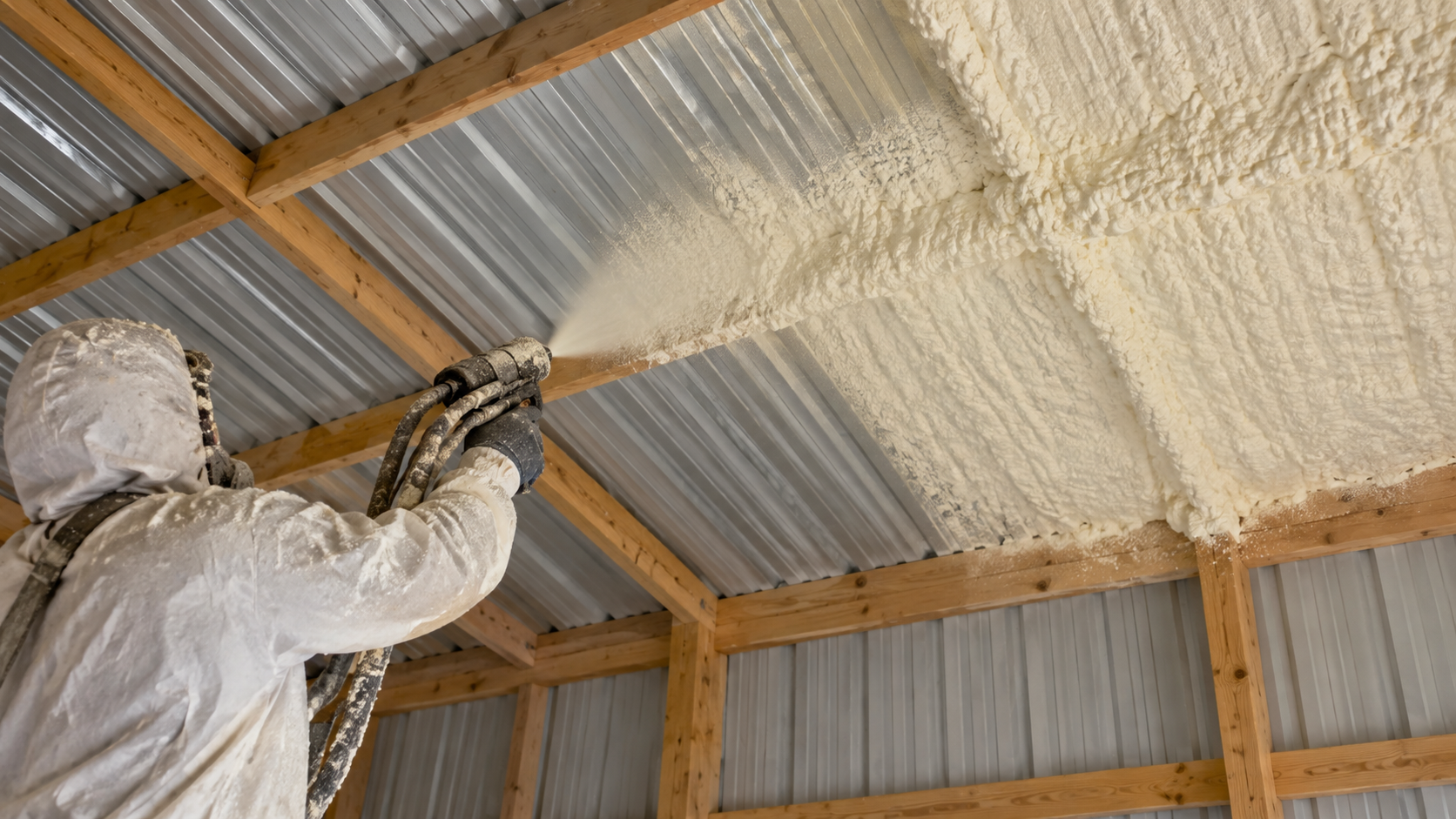
Closed-cell spray foam adheres directly to the metal surface, filling every rib, seam, and fastener point. There is no gap between the foam and the panel, which means there is no surface for condensation to form on. The foam acts as both a thermal barrier and a vapor barrier simultaneously.
For a typical Republic shop or pole barn, we spray closed-cell foam to the underside of the roof panels and the interior face of the wall panels. The result is a building that holds temperature, stays dry, and is significantly more comfortable to work in year-round.
Comparing Foam Options for Metal Buildings
Closed-Cell Foam R-value: approximately 6.5 to 7 per inch Vapor control: Class II vapor retarder — stops moisture migration Adhesion: bonds directly to metal panels Best for: roof panels, exterior walls, any area with moisture exposure
Open-Cell Foam R-value: approximately 3.5 to 4 per inch Vapor control: vapor-permeable — not recommended where moisture is a primary concern Adhesion: adheres to metal but is softer and more flexible Best for: interior partition walls, sound control applications
For most Republic shops and barns, closed-cell is the right choice. The higher R-value per inch means less thickness is needed to hit a target insulation level, which matters in buildings where interior clearance is important.
What a Republic Job Looks Like
Most residential spray foam jobs in Republic take one to two days. A full attic and crawl space on a 1,800-square-foot home is typically a one-day project. A metal shop in the 40x60 to 50x80 range usually runs one to two days depending on the height of the walls and the complexity of the roof line.
We work out of Marshfield and cover all of Republic and the surrounding areas in Greene County. Jobs are scheduled based on weather — spray foam requires temperatures above a certain threshold to cure properly, and we do not spray in rain or high wind conditions.
Frequently Asked Questions
Does spray foam work in Republic's climate?
Yes. Republic's mixed-humid climate is exactly the environment spray foam was designed for. The combination of air sealing and moisture control addresses the two primary failure modes of traditional insulation in this region: air leakage and moisture accumulation.
How long does spray foam last in a metal building?
Closed-cell spray foam is a permanent installation. It does not settle, sag, or compress over time the way fiberglass does. Once it cures, it maintains its R-value and air-sealing properties for the life of the building. We have seen foam installations in metal buildings that are decades old and still performing as intended.
Can spray foam be added to an existing Republic home without major renovation?
In most cases, yes. Attic and crawl space applications do not require any demolition — we access those areas through existing openings. Wall cavity insulation in existing homes requires either injection foam (through small holes drilled from the exterior) or open-wall access. We assess each home individually and recommend the least invasive approach that achieves the homeowner's goals.
Bottom line:
Republic homes and shops face the same Missouri climate challenges as the rest of Greene County — but spray foam gives you a permanent solution that handles both air sealing and moisture control in one installation.
We serve Republic and the surrounding communities across Greene, Christian, and Webster counties. If you are ready to talk through your home or shop, visit our Republic spray foam insulation page or learn more about our pole barn and shop insulation services. Call us at 417-224-8734 or stop by our office at 140 York Dr, Marshfield MO 65706.