
How Thick Should Spray Foam Be? Attic, Wall, Crawl Space, and Metal Roof Depths in Missouri
Spray foam insulation thickness varies by location and foam type. Learn the right depths for attics, walls, crawl spaces, and metal roofs in Missouri.
How Thick Should Spray Foam Be? Attic, Wall, Crawl Space, and Metal Roof Depths in Missouri
Spray foam insulation thickness is not one-size-fits-all — the right depth depends on where you are installing it, which type of foam you choose, and what performance you need in Missouri's mixed climate. We install spray foam across Greene, Christian, and Webster counties every week, and the question we hear most often is: how many inches do I actually need?
Why Spray Foam Insulation Thickness Matters
Thickness drives R-value, and R-value determines how well your building resists heat flow. But thickness also controls moisture management. Too thin and you may not reach the dew point control needed to prevent condensation — especially on metal surfaces. Too thick in the wrong location and you are spending money on diminishing returns. Getting the depth right the first time is the difference between a comfortable, dry building and one that sweats, drafts, or runs high utility bills year-round.
Open-Cell vs. Closed-Cell: R-Value Per Inch
Before we talk about specific depths, you need to know what each foam type delivers per inch, because that determines how thick you need to go.
Open-Cell spray foam R-value per inch: approximately R-3.5 to R-3.8 per inch. Open-cell foam is soft, flexible, and expands aggressively to fill irregular cavities. It is a good air barrier but is vapor-permeable, meaning moisture can pass through it over time.
Closed-cell spray foam R-value per inch: approximately R-5.6 to R-7.0 per inch depending on density. Closed-cell foam is rigid, dense, and acts as a Class II vapor retarder. It adds structural strength to walls and roof panels and is the correct choice anywhere moisture control is critical.
The practical takeaway: to reach the same R-value, you need roughly twice as many inches of open-cell foam as closed-cell foam.
Attic Spray Foam Insulation Thickness
Attics are the most common application we handle in Springfield, Nixa, Ozark, and the surrounding area. There are two fundamentally different attic strategies, and each calls for a different thickness target.
Vented attic (insulating the floor) In a vented attic, insulation goes on the attic floor — the ceiling of your living space below. Open-cell foam works well here. To reach the performance level most Missouri homeowners target, plan on 5 to 6 inches of open-cell foam on the attic floor, which delivers roughly R-18 to R-22. Many homeowners layer additional blown-in insulation on top to reach higher totals.
Unvented (conditioned) attic — insulating the roof deck When we spray the underside of the roof deck to create a conditioned attic, the foam must do two jobs: insulate and control condensation at the sheathing. For this application, we use closed-cell foam or a hybrid approach. Missouri's climate zone requires a minimum R-value of air-impermeable insulation at the roof deck to keep the sheathing above the dew point. We typically install 3 to 4 inches of closed-cell foam on the roof deck underside, which delivers R-18 to R-28 depending on the product, and then fill the remaining rafter depth with open-cell foam if additional R-value is needed.
Learn more about our attic spray foam insulation process and what to expect on installation day.
Wall Spray Foam Insulation Thickness
Wall cavities are constrained by stud depth, so the question is less about how thick and more about which foam fits the cavity.
2x4 stud walls (3.5-inch cavity) Closed-cell foam fills a 2x4 cavity completely at 3.5 inches, delivering approximately R-20 to R-24. This is a strong thermal and moisture performance in a single product. Open-cell foam at 3.5 inches delivers roughly R-12 to R-13 — adequate for interior partition walls but often supplemented with exterior continuous insulation for exterior walls in Missouri's climate.
2x6 stud walls (5.5-inch cavity) A full fill of closed-cell foam in a 2x6 wall delivers R-31 to R-38. More commonly, we install 2 inches of closed-cell foam (R-12 to R-14) as a vapor retarder and air barrier, then fill the remaining 3.5 inches with open-cell foam or fiberglass — a technique called flash-and-batt that balances performance and cost.
Crawl Space Spray Foam Insulation Thickness
Crawl space encapsulation is one of the highest-return projects we do for homeowners in Webster and Christian counties. When we spray the interior of foundation walls and the rim joist, we use closed-cell foam because moisture control is the primary goal.
Foundation walls 2 inches of closed-cell foam on the interior of a concrete or block foundation wall delivers R-12 to R-14 and creates a continuous vapor barrier. This is the minimum we recommend for a fully conditioned crawl space.
Rim joist The rim joist is one of the biggest air leak points in any home. We spray 2 to 3 inches of closed-cell foam directly into the rim joist cavity, sealing it completely. This single detail often produces a noticeable improvement in comfort on the first floor above.
Crawl space encapsulation typically runs $2,500 to $8,000 depending on the size and condition of the space. See our crawl space spray foam page for a full breakdown of what the process includes.
Metal Roof and Metal Building Spray Foam Thickness
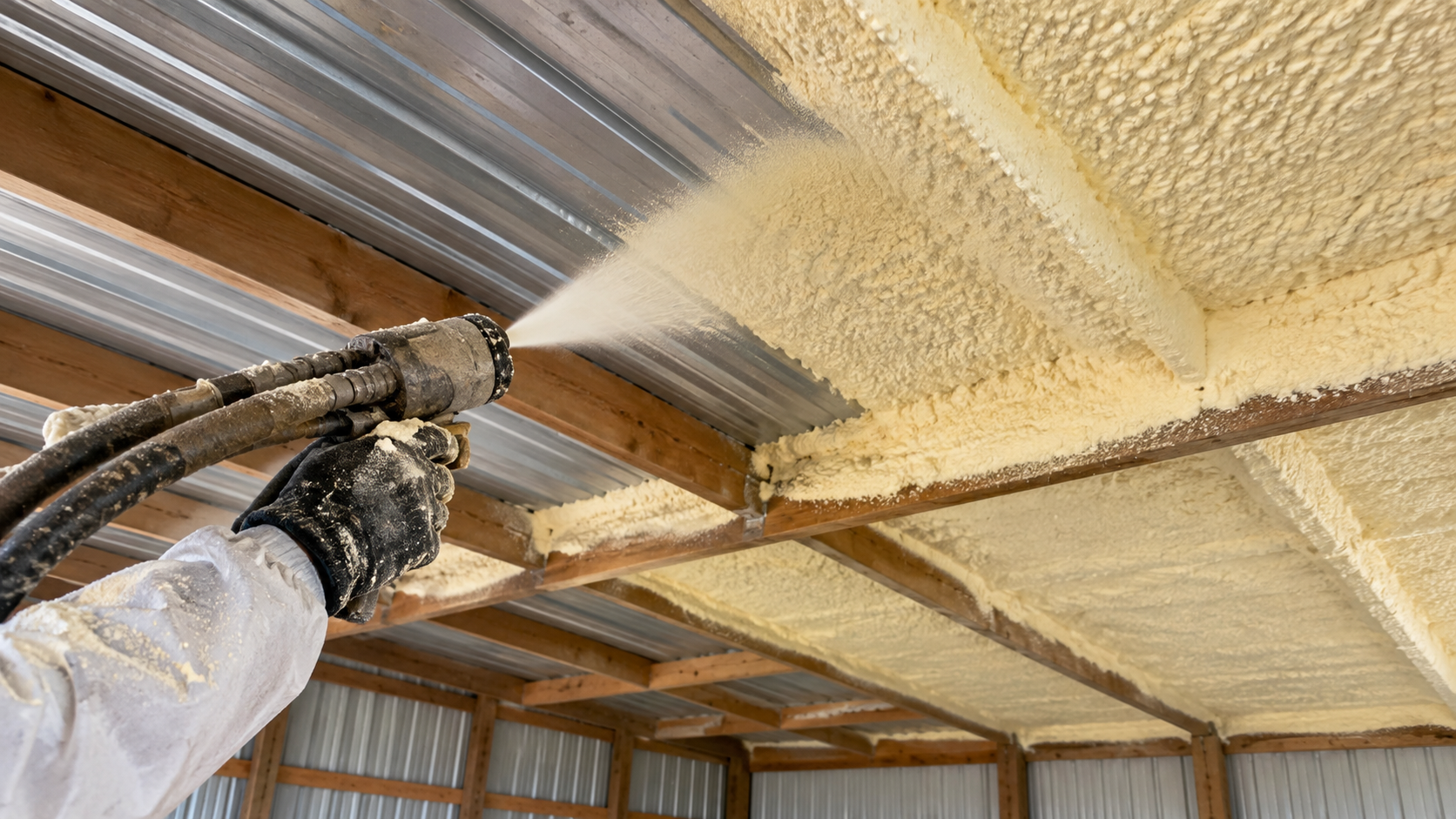
Metal buildings — pole barns, shops, agricultural structures — are where spray foam insulation thickness is most critical. Metal is highly conductive and will sweat when warm, humid interior air contacts the cold metal surface. The only reliable fix is closed-cell spray foam applied directly to the underside of the metal panels.
Minimum for condensation control Industry guidance establishes 1 inch of closed-cell foam as the absolute minimum to create a functional vapor barrier and stop surface condensation. At 1 inch you get approximately R-6 to R-7 — enough to prevent sweating but not enough for meaningful thermal performance in Missouri winters.
Recommended for Missouri climate For a shop or barn you heat in winter, we recommend 2 to 3 inches of closed-cell foam on the roof panels and walls. Two inches delivers R-12 to R-14 and keeps the metal surface well above the dew point even on the coldest nights in Webster County. Three inches pushes you to R-18 to R-21 and is appropriate for buildings where you want to maintain a consistent interior temperature with reasonable heating costs.
Full thermal performance For a conditioned metal building — a workshop you heat and cool year-round — 3 to 4 inches of closed-cell foam on the roof and 2 to 3 inches on the walls is the range we typically recommend. This delivers whole-building performance that can reduce energy use by up to 40% compared to an uninsulated metal structure.
Frequently Asked Questions
How many inches of spray foam do I need in my attic? It depends on whether you are insulating the attic floor or the roof deck. For a conditioned attic (roof deck application), we typically install 3 to 4 inches of closed-cell foam at the deck, which controls condensation and delivers R-18 to R-28. For an attic floor application using open-cell foam, 5 to 6 inches is a common starting point.
Can I use open-cell foam in a crawl space? We do not recommend open-cell foam for crawl space foundation walls or rim joists. Open-cell foam is vapor-permeable, which means moisture from the soil and exterior can migrate through it over time. Closed-cell foam is the correct product for any below-grade or moisture-exposed application.
Does thicker spray foam always mean better results? Not always. There is a point of diminishing returns — each additional inch of foam adds less incremental R-value than the inch before it. The goal is to reach the right performance level for your application, not to maximize thickness. We assess each project individually and recommend the depth that delivers the best outcome for your specific building and budget.
Bottom line:
Spray foam insulation thickness depends on the application — attic floor, roof deck, wall cavity, crawl space, or metal building — and on whether you choose open-cell or closed-cell foam. We install the right product at the right depth for every job we take on in Springfield, Nixa, Ozark, Republic, Battlefield, Rogersville, Willard, and Marshfield.
Call Foam Fortress at 417-224-8734 or visit our attic spray foam insulation page to get a quote for your home or building.